Honors Life at Whitworth

Recent:

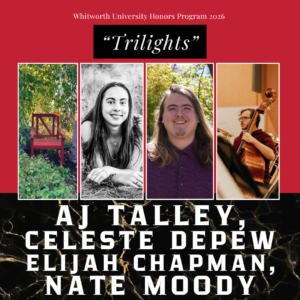
AJ Talley, Celeste Depew, Elijah Chapman, Nate Moody

Trilights is an interactive video game that focuses on character and storytelling, aiming to present a new synthesis between the literary and the ludomechanical (game-playing). As an interdisciplinary project, Trilights allows a further exploration of the possibilities of creative writing, acoustic arts, artistic expression, and well-designed programming.

Read More »

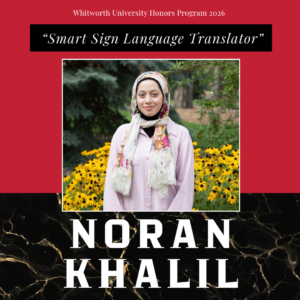
Noran Khalil

My honors project addresses this gap by developing a sign language translator application, functioning similarly to Google Translate. The app features a keyboard that displays ASL signs as images, allowing users to either select signs directly to communicate in sign language or type words normally and have them translated into the corresponding signs. This application is built with one goal in mind: to ensure that every person, regardless of hearing ability, can communicate effectively and with dignity.

Read More »

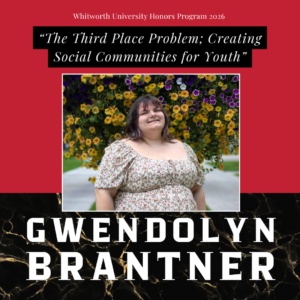
Gwendolyn Brantner

My project investigates the third place problem, a topic which has recently gained traction online in gen z communities as we try to gain some adult social life once leaving school. Third places are defined as space outside of home (1st place) and work/school (2nd place) in which individuals spend a large portion of time socializing and connecting with their community. The traditional sense of the phrase requires that third place be free to access, easy to access, and full of opportunities for social connection with those both similar and opposite to you. This topic has always interested me and I am a strong advocate for people having fulfilling social lives outside of family and outside of obligation. Considering my future career path, I focused my project on third places and youth, specifically. My project begins by investigating the reasons for the decline in third spaces in the 21st century due to cultural shifts, technological developments, and even legal constraints. Then, I present why the lack of these spaces is detrimental, particularly to youth populations ages 12-17, when it is so easy to disappear into online spaces instead. My research concludes by offering up some examples of ideal solutions for youth populations and their guardians, considering accessibility and safety concerns that many guardians have about sending children to third places. With proper support and engagement the youth programs and non-profits which offer third space solutions could be the key to maintaining the social health of younger generations despite the many barriers to finding community.

Read More »

Zoe Montgomery

I have always had a passion for understanding learning styles and differentiating instruction based on those styles. Throughout my own education, I have been aware that I am a visual learner, which has helped me choose learning and study habits best suited for me. As a future elementary school teacher, I wanted to explore how teachers can better teach to various learning styles in their classrooms. I believe that we can increase the success of our students when we plan our classrooms and lessons with their learning styles in mind. Building differentiation for learning styles into lesson plans can allow students to engage in the content in the way that best suits them. When I came up with the idea for this project, I wanted to learn more about the improvements teachers can make and why they should make them. One conclusion that I have come upon is that this can be a time-consuming process, though a worthwhile one. When lessons are planned around learning styles, students are more engaged because the content feels more accessible to them. Students also become more able to grasp complex concepts because the information is presented in multiple ways. Among the many other benefits, learning style modifications are a great way to support diverse learners. My project aims to inform my future teaching and educate others on the importance of planning a classroom with learning styles in mind.

Read More »

Upcoming Opprotunities:

Spring Honors Lunch

The first Honors Lunch Network of the Spring semester focused on how to get internships and faculty research assistantships.

Read More »

Fall 2024 Showcase

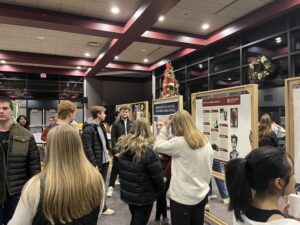
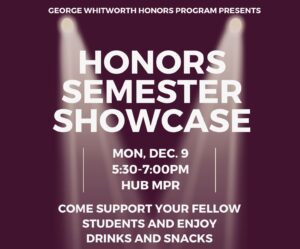
Come admire Honors student research, final projects, and creative works in the HUB MPR from 5:30-7:00PM on Monday December 9th.

Read More »

Internships:

On-Campus Spotlights:

Fall 2024 Showcase

Come admire Honors student research, final projects, and creative works in the HUB MPR from 5:30-7:00PM on Monday December 9th.

Read More »

Summer Fellowship Program

Whitworth’s Office of Church Engagement runs the Summer Fellowship Program, which places students with churches, camps, and nonprofits nationwide.

Read More »

Study Abroad:

A Day in the Life: Jan Term in Italy

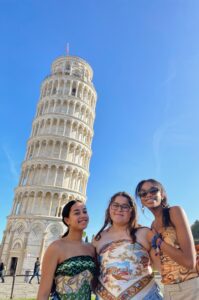
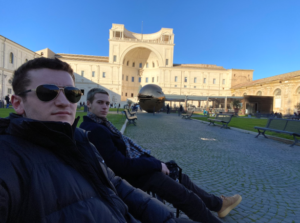
During Jan Term 2023, a group of freshmen Honors students took a trip to Italy. Part of the trip was a day spent in the Academia followed by watching a game of football (soccer). Read about the experience written by two of the students on the trip.

Read More »

Research:

AJ Talley, Celeste Depew, Elijah Chapman, Nate Moody

Trilights is an interactive video game that focuses on character and storytelling, aiming to present a new synthesis between the literary and the ludomechanical (game-playing). As an interdisciplinary project, Trilights allows a further exploration of the possibilities of creative writing, acoustic arts, artistic expression, and well-designed programming.

Read More »

Noran Khalil

My honors project addresses this gap by developing a sign language translator application, functioning similarly to Google Translate. The app features a keyboard that displays ASL signs as images, allowing users to either select signs directly to communicate in sign language or type words normally and have them translated into the corresponding signs. This application is built with one goal in mind: to ensure that every person, regardless of hearing ability, can communicate effectively and with dignity.

Read More »

Gwendolyn Brantner

My project investigates the third place problem, a topic which has recently gained traction online in gen z communities as we try to gain some adult social life once leaving school. Third places are defined as space outside of home (1st place) and work/school (2nd place) in which individuals spend a large portion of time socializing and connecting with their community. The traditional sense of the phrase requires that third place be free to access, easy to access, and full of opportunities for social connection with those both similar and opposite to you. This topic has always interested me and I am a strong advocate for people having fulfilling social lives outside of family and outside of obligation. Considering my future career path, I focused my project on third places and youth, specifically. My project begins by investigating the reasons for the decline in third spaces in the 21st century due to cultural shifts, technological developments, and even legal constraints. Then, I present why the lack of these spaces is detrimental, particularly to youth populations ages 12-17, when it is so easy to disappear into online spaces instead. My research concludes by offering up some examples of ideal solutions for youth populations and their guardians, considering accessibility and safety concerns that many guardians have about sending children to third places. With proper support and engagement the youth programs and non-profits which offer third space solutions could be the key to maintaining the social health of younger generations despite the many barriers to finding community.

Read More »

Zoe Montgomery

I have always had a passion for understanding learning styles and differentiating instruction based on those styles. Throughout my own education, I have been aware that I am a visual learner, which has helped me choose learning and study habits best suited for me. As a future elementary school teacher, I wanted to explore how teachers can better teach to various learning styles in their classrooms. I believe that we can increase the success of our students when we plan our classrooms and lessons with their learning styles in mind. Building differentiation for learning styles into lesson plans can allow students to engage in the content in the way that best suits them. When I came up with the idea for this project, I wanted to learn more about the improvements teachers can make and why they should make them. One conclusion that I have come upon is that this can be a time-consuming process, though a worthwhile one. When lessons are planned around learning styles, students are more engaged because the content feels more accessible to them. Students also become more able to grasp complex concepts because the information is presented in multiple ways. Among the many other benefits, learning style modifications are a great way to support diverse learners. My project aims to inform my future teaching and educate others on the importance of planning a classroom with learning styles in mind.

Read More »