Honors Life at Whitworth

Recent:

Experiencing the Theatre in London

Over the course of the 2026 Jan term trip to London I had the privilege of attending nine different stage productions, all very different, but all equally valuable to my experience studying abroad. It was an opportunity I had never had before to be able to go somewhere where dozens of shows of West End quality were all playing at the same time. I bought as many tickets as I reasonably could with my budget and aimed to get the maximum value out of each show I saw. Over the course of the trip, I gained a renewed appreciation for the performance arts and their value, not only to British culture, but society in general.

Read More »

Wahiawā Botanical Gardens: The Art and Tradition of Lei Making

At the Wahiawā Botanical Gardens, the practice of lei making is taught to visitors, both to carry on the tradition and teach the significance of the weave to visitors, but also to aid in the onerous task of weaving approximately 53,000 lei for Memorial Day. The Wahiawā Botanical Gardens contributes 7,000 natural lei every year to the project. In the hour and a half the Whitworth students were there, we made one hundred woven Ti lei. Hundreds of organizations run similar lei making sessions for the five months leading up to Memorial Day, freezing the lei braids to keep them until May.

Read More »

Haoles in Hawaii: Trip to the Polynesian Culture Center

On the 5th day of the First Year Honors group’s stay in Hawaii, we visited the Polynesian Cultural Center. After a long, sun drenched day full of information, performances, and beautiful scenery, most of us came away with a deeper understanding of Polynesian culture and the complex traditions preserved in places like the PCC (Polynesian Cultural Center).

Read More »

Beach Cleanup on Mokulē‘ia Army Beach: A Jan Term in Hawai’i

To end our first week on the island of O’ahu, Hawai’i, the 2026 Jan term Honors class went down to Mokulē‘ia Army Beach, a 2-minute drive from our camp, to clean up trash from the beach for an hour. We split up into groups of 3 to 6, turning our project into a little competition of which group could collect the most trash.

Read More »

Upcoming Opprotunities:

Honors: Courses for Fall 2023

George F. Whitworth Honors Program: Fall 2023 Offerings Questions: Contact Honors Director Dr. Bert Emerson at dbemerson@whitworth.edu Shared Curriculum Offerings Upper Division “H” and Major

Read More »

Spring 2023: Honors Events

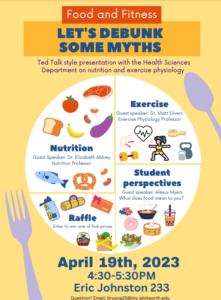
In Spring of 2023, the Honors program will be offering a few honors-specific and campus-wide events. Mark your calendar using the list below, so you can be sure you won’t miss out on these amazing opportunities!

Read More »

Calling All Majors: Tech Start Up Competition

Did you ever have a great idea for a start up but didn’t know how to get started? This weekend will be perfect for you! Join a team of interdisciplinary students to build the idea from the ground up and pitch it to a team of judges to win prize money!

Read More »

Internships:

On-Campus Spotlights:

Research on the River

Hannah Neuberger, a senior majoring in biology, is researching the level of polychlorinated biphenyls (PCB’s) in the Spokane River in her HN 400 class.

Read More »

Study Abroad:

DOA-LA19: The Huntington

#DOA-LA19: The Huntington by Ethan Paxton, ’22 A massive compound spanning a whopping 207 acres, The Huntington Library, Art Collections, and Botanical Gardens is perhaps

Read More »

Research:

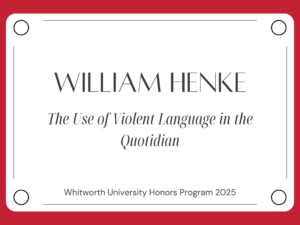
William Henke

Modern language has become violent in a way that abstracts our words from their actual meanings. Phrases like “slay” “break a leg” “you’re killing it” and many others reveal how violence has settled into quotidian linguistics. This reorientation towards violence desensitizes people to its larger social implications and promotes inadequate communication. Language that was once, and by dictionary definition still is, seen as violent or harmful is now utilized in neutral or even uplifting ways. Desensitization towards larger problems in society like gun violence, racism, global warming, etc. engenders an escalation of language in order to gain an appropriate reaction to said issues.

Read More »

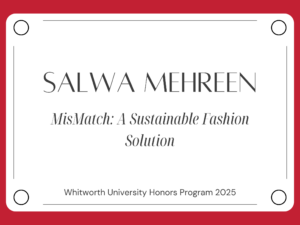
Salwa Mehreen

My project, MisMatch, started from a real-life frustration — how much time and energy it takes just to pick an outfit. Research shows that people spend around 102 hours a year deciding what to wear (Marks & Spencer), and about 50% of Americans say it’s the most stressful part of getting ready for an event (Trunk Club). At the same time, the fast fashion industry produces around 92 million tons of textile waste each year (UNEP), most of which ends up in landfills. I wanted to create something that helped people in their everyday lives while also promoting more sustainable habits.

Read More »

Melinda Mullet

Aging Americans and their caregivers should have easy access to dignifying end-of-life care. The rapid increase in the 65+ population requires policy innovation in current Medicare regulation concerning hospice. Coordinated, intentional efforts between government and private sector providers, insurance navigators, community organizations, and houses of worship are also needed to change public attitudes towards hospice care, encourage referrals, increase uptake, and offer emotional, psychological, and spiritual support.

Read More »

Jude Ruetschle

Broadly speaking, our world tends to see religion as a sort of ‘meaning-making’ device. In faith, one is able to carve divine order into the chaos and fragmentation of the human experience. This makes faith a vehicle for hope—for settling the existential realization that nothing in our lives makes sense. The premise of this project, however, challenges that assumption: What if grasping after order and unity is not a source, but an obstruction to our ability to embrace life?

Read More »