Microfluidics on the National Stage
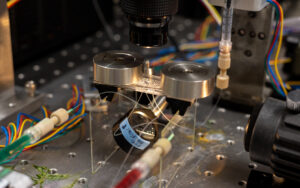
Noran Khalil is an Honors Bioinformatics senior working closely with Dr. Measor in the microdevices lab. Khalil has presented her research at several large conferences in the U.S.

Noran Khalil is an Honors Bioinformatics senior working closely with Dr. Measor in the microdevices lab. Khalil has presented her research at several large conferences in the U.S.

On the 2026 Honors Hawaii Jan term trip, we had the opportunity to visit the Bishop Museum. The Bishop Museum is located in sunny Honolulu and is the official Museum of Natural and Cultural History of Hawaii. Here we had the joy of exploring several fascinating exhibits, including sections devoted to Hawaiian and Polynesian history, natural science, and even dinosaurs!

Over the course of the 2026 Jan term trip to London I had the privilege of attending nine different stage productions, all very different, but all equally valuable to my experience studying abroad. It was an opportunity I had never had before to be able to go somewhere where dozens of shows of West End quality were all playing at the same time. I bought as many tickets as I reasonably could with my budget and aimed to get the maximum value out of each show I saw. Over the course of the trip, I gained a renewed appreciation for the performance arts and their value, not only to British culture, but society in general.

At the Wahiawā Botanical Gardens, the practice of lei making is taught to visitors, both to carry on the tradition and teach the significance of the weave to visitors, but also to aid in the onerous task of weaving approximately 53,000 lei for Memorial Day. The Wahiawā Botanical Gardens contributes 7,000 natural lei every year to the project. In the hour and a half the Whitworth students were there, we made one hundred woven Ti lei. Hundreds of organizations run similar lei making sessions for the five months leading up to Memorial Day, freezing the lei braids to keep them until May.

Honors Lunch Network, Fall 2024: Democracy and Discourse We live in an age of polarizing opinion and shrinking common ground. The theme for this

Next spring, SC-126: Infinite and the Void will become an Honors class, allowing it to count towards Honors credit for Honors students.
This course examines concepts of math through an interdisciplinary lens. Charlie Rodriguez, a senior math major who TA’d for the class, said that people often think that mathematics has no meaningful connection to life. He says this “couldn’t be further from the truth.”

Jade Truong, a senior who is majoring in health sciences, is using Honors to connect with the community by hosting an teaching event about personal nutrition and exercise.
Are you passionate about Honors and looking for an on-campus job? The Honors Program is hiring for four separate positions! Click here to learn more about the positions and how to apply.

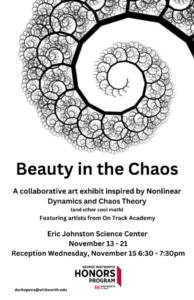
This upcoming week from November 12-21, the Eric Johnson Science Center will be hosting “Beauty in the Chaos”, a collaborative art exhibit inspired by Nonlinear

As I look back on my past four years at Whitworth, there are many opportunities, lessons and people that I am very grateful for. As a part of the group of students who endured the wrath of COVID-19 on their college experience, these past four years have been hard. Now that I have made it on to the other side and have adorned my cap and gown, I can say the growth I have experienced has been very rewarding.

Sarah Immel, a senior double majoring in human computer interactions and English writing studies, is using the Honors program as a way to merge the different interests in her majors and design interdisciplinary projects.

Hannah Stoddard, who is majoring in international studies, found that Honors has given her a way to connect her major, her personal experiences, and her passion. The intersection of these different parts of Hannah’s life has resulted in a pool project aimed to improve local communities.
#DOA-LA19: Days 4 Wicked at the Pantages by Claire Buchheit, ’21 “She’s crispy. She’s like bacon.” – Annika Bjornson, 8 January 2019 On the evening
#DOA-LA19: The Broad Museum by Laurelle Watkins, ’22 Hi readers, my name is Laurelle Watkins and I am a freshman biochemistry major. I went on
#DOA-LA19: Days 1 and 2 Watts Towers, the Getty Museum, and LACMA by Daniel Roberts, ’20 “What did you go out into the wilderness to see?
#DOA-LA19: A History of Film Studios by Bryn Cavin, ’20 Nikki Hevesy is the VP of Media Strategies for Artists for Community Transformation, a nonprofit

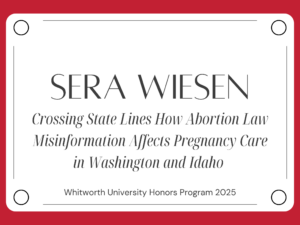
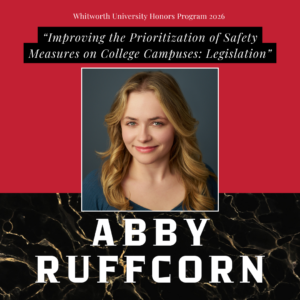
With the overturing of Roe V Wade came a plague of misinformation surrounding reproductive health. This led to medical practitioners and specialists being misinformed and fearing prosecution for providing lifesaving procedures on pregnant women. Reproductive healthcare doesn’t just involve abortion, it includes emergency care, about the right to survive a pregnancy. The misinformation flooding the system is making everything worse. State laws are murky and full of vague language state by state, leaving medical professionals unsure if they’d be prosecuted for providing necessary, lifesaving care for their patients. To me, it is wrong that in a first world country, people are left to suffer because of this misinformation. My goal is to bring light to proper information about abortion care even in the most restrictive states.

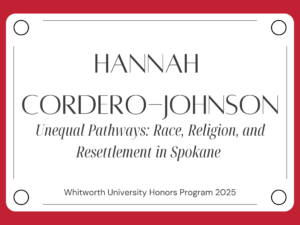
Immigration has long been a contentious issue in the U.S., but recent years have seen increasingly negative public attitudes shaped by race, religion, politics, and nationalism. Notably, research shows that white evangelical Christians often support restrictive immigration policies—despite professing compassion and a biblical call to welcome the stranger. This study explores how those contradictions play out locally in Spokane, Washington, by centering the voices of immigrants and refugees and examining how race, religion, and legal status shape their resettlement experiences.

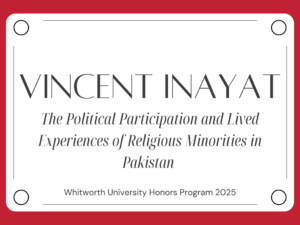
My honors capstone project investigates how systemic marginalization affects the political participation and lived experiences of religious minorities in Pakistan, focusing particularly on Christian communities in Karachi. Through qualitative research involving semi-structured interviews, I examined how fear, discrimination, and historical shifts in state ideology contribute to political disengagement. Participants expressed deep frustration with exclusionary practices, legal discrimination through blasphemy laws, and socio-economic disenfranchisement. Yet, I also uncovered stories of remarkable resilience such as communities leveraging civil society, clustering in safe neighborhoods, and using social media as new platforms for political expression.

As a Christian in the science field, these two dominant fields have always been a big part of my learning and worldview. During our time at Cambridge, we read a book by Yuval Harari titled Sapeins. In this book, Yuval Harari is attempting to tell the story of science throughout human history. I observed that in this attempt, Harari is guilty of placing science in a bubble, ignoring big changes going on in the world, specifically around the Scientific Revolution. This realization, paired with my strong passion and fascination for science and religion, led me to desire to be able to better prove that these two fields are not in conflict.
We use cookies to improve your experience on our site. By using our site, you consent to cookies.
Websites store cookies to enhance functionality and personalise your experience. You can manage your preferences, but blocking some cookies may impact site performance and services.
Essential cookies enable basic functions and are necessary for the proper function of the website.
These cookies are needed for adding comments on this website.
Statistics cookies collect information anonymously. This information helps us understand how visitors use our website.
Google Analytics is a powerful tool that tracks and analyzes website traffic for informed marketing decisions.
Service URL: policies.google.com (opens in a new window)