Honors Life at Whitworth

Recent:

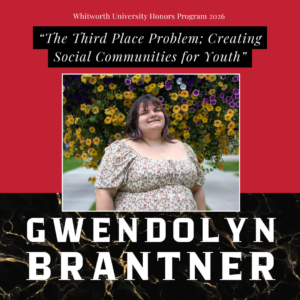
Gwendolyn Brantner

My project investigates the third place problem, a topic which has recently gained traction online in gen z communities as we try to gain some adult social life once leaving school. Third places are defined as space outside of home (1st place) and work/school (2nd place) in which individuals spend a large portion of time socializing and connecting with their community. The traditional sense of the phrase requires that third place be free to access, easy to access, and full of opportunities for social connection with those both similar and opposite to you. This topic has always interested me and I am a strong advocate for people having fulfilling social lives outside of family and outside of obligation. Considering my future career path, I focused my project on third places and youth, specifically. My project begins by investigating the reasons for the decline in third spaces in the 21st century due to cultural shifts, technological developments, and even legal constraints. Then, I present why the lack of these spaces is detrimental, particularly to youth populations ages 12-17, when it is so easy to disappear into online spaces instead. My research concludes by offering up some examples of ideal solutions for youth populations and their guardians, considering accessibility and safety concerns that many guardians have about sending children to third places. With proper support and engagement the youth programs and non-profits which offer third space solutions could be the key to maintaining the social health of younger generations despite the many barriers to finding community.
Read More »

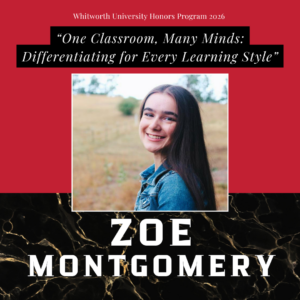
Zoe Montgomery

I have always had a passion for understanding learning styles and differentiating instruction based on those styles. Throughout my own education, I have been aware that I am a visual learner, which has helped me choose learning and study habits best suited for me. As a future elementary school teacher, I wanted to explore how teachers can better teach to various learning styles in their classrooms. I believe that we can increase the success of our students when we plan our classrooms and lessons with their learning styles in mind. Building differentiation for learning styles into lesson plans can allow students to engage in the content in the way that best suits them. When I came up with the idea for this project, I wanted to learn more about the improvements teachers can make and why they should make them. One conclusion that I have come upon is that this can be a time-consuming process, though a worthwhile one. When lessons are planned around learning styles, students are more engaged because the content feels more accessible to them. Students also become more able to grasp complex concepts because the information is presented in multiple ways. Among the many other benefits, learning style modifications are a great way to support diverse learners. My project aims to inform my future teaching and educate others on the importance of planning a classroom with learning styles in mind.

Read More »

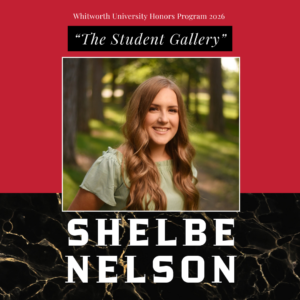
Shelbe Nelson

Growing up, I’ve always had an affinity towards creativity, art-hobbying, and music. They bring me joy and personal flourishing outside of my every-day life. I think that it is a large part of being human. What inspired my work is the recent conflict between social media platforms and artists. Over the recent years, the content of visual and musical artists have been subjugated to constant thieving of their work by AI and being buried due to biased media algorithms. In a time where many careers are put under threat by replacement via AI, I want to make a change, even if it is a small one. My career of studying marketing and economic tactics has taught me how to be a voice for those who need it. So I have decided to put my skills to the test and bring light to my peers even in these uncertain times.

Read More »

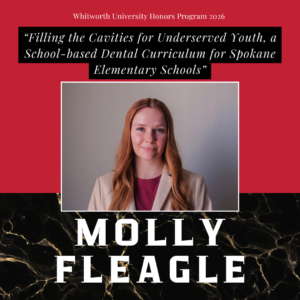
Molly Fleagle

Access to affordable and preventive dental care remains a significant challenge in Spokane, Washington, particularly for children in low-income, minority, and non-English-speaking families. Many residents with Apple Health coverage, the dental care insurance for low-income families, still face barriers to treatment due to limited provider participation and low reimbursement rates. Compounding these disparities, Spokane is the largest city in Washington that has not implemented water fluoridation, contributing to higher rates of untreated tooth decay among children. This project seeks to address these oral health inequities by developing a proposal advocating for school-based preventive dental programs and curricula, specifically brushing techniques, the truth about cavities, and demonstrations in Spokane’s low-income elementary schools. Ultimately, this work seeks to improve equitable access to dental care for Spokane’s children and contribute to long-term community health outcomes.

Read More »

Upcoming Opprotunities:

Summer Fellowship Program

Whitworth’s Office of Church Engagement runs the Summer Fellowship Program, which places students with churches, camps, and nonprofits nationwide.

Read More »

New Computer Science Degrees for 2024

As technology evolves at a rapid pace, so must education. The Whitworth University Computer Science department is excited to announce new degrees for the 2024 academic year, reflecting years of thoughtful dialogues between faculty and students, feedback, and a commitment to inclusivity and interdisciplinary learning. 

Read More »

Internships:

On-Campus Spotlights:

Honors Floor Past and Present

Honors Floor Past and Present At Whitworth, first-year Honors students have the unique opportunity to join the Honors Floor learning community. From 2021-2023, the Honors

Read More »

Study Abroad:

Research:

Fall 25 Wrap Up

This Fall semester went by fast! With many speakers on campus, a new Democracy Lab, Honors Lunches galore, a new Co-Director Joy York, Banned Books week, many literary journals, and mentorship opportunities it’s no surprise we lost track of time!

Read More »