Honors Capstone Projects

Video made with the assistance of Samuel Ortega ’25

All George Whitworth Honors students complete an individual project as part of their Honors Curriculum, cultivating skills of problem-solving, project proposals, and project management.


Projects may be academic or applied but in some way reflect the Honors Program’s Mission:


The Whitworth Honors Program challenges talented and motivated scholars to pursue excellence of mind and heart, to cultivate leadership qualities and skills, and to commit to lives of service. The Honors Program does more than guide scholars to navigate the world as it is; it equips them to solve problems and to develop the world as it should be.”

Click the links below to get a sense of what students have been doing!

Melinda Mullet

Aging Americans and their caregivers should have easy access to dignifying end-of-life care. The rapid increase in the 65+ population requires policy innovation in current Medicare regulation concerning hospice. Coordinated, intentional efforts between government and private sector providers, insurance navigators, community organizations, and houses of worship are also needed to change public attitudes towards hospice care, encourage referrals, increase uptake, and offer emotional, psychological, and spiritual support.

Read More »

Jacob Soo

One of the main reasons that kids quit sports is because of poor coaching. When coaches are hired, they are often not properly trained. This project aims to fill a gap in the research when it comes to youth sports coaching and training and can be a valuable piece for coaching journals and local athletic associations. This project also sheds light on how youth sports coaches could be more comprehensively trained and can be valuable to any parent seeking a better athletic experience for their child. This project does not only focus on the basic skills needed for youth sports coaches, like CPR and first aid, but also on more complex skills like emotional control and creating an inclusive space for young athletes.

Read More »

Kae Benton

KAE BENTON Class of 2024. Biochemistry Major. As a student who has spent many hours in biology and chemistry classes, I have fostered a deep

Read More »

Megan Necochea

MEGAN NECOCHEA Megan is an undergraduate student at Whitworth University pursuing her Bachelor’s in English. She is the editor-in-chief of Script Magazine and the nonfiction editor of Rock and

Read More »

Evan Galle

Many college students arrive on campus without a clear picture of their semester-to-semester education actually costs or how to manage it. Watching Whitworth University peers navigate financial stress often without adequate tools or guidance, inspired me to complete this project. A personalized budgeting spreadsheet built exclusively for Whitworth students

The central question driving this project was: how can a practical, student-financial tool be designed to make budgeting accessible, accurate, and actionable for Whitworth students specifically? I found that generic budgeting advice and one-size-fits-all templates fail to account for the unique situations Whitworth students face. Students are having to juggle the various fees associated with attending, the different room and board types, and the realities of student jobs that help the budget, this project addresses the gap directly.

Read More »

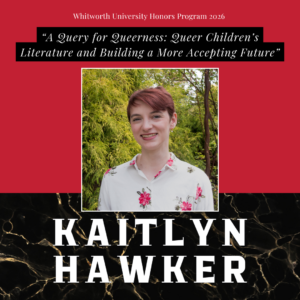
Kaitlyn Hawker

With the legalization of gay marriage in 2015, legal queer families entered the societal view. However, normalization cannot happen without positive visibility, which usually comes in the form of representation in the media society consumes. Queer characters in movies, tv shows, and adult books have appeared for decades, sometimes even centuries, but limiting queer representation to adult-only content does more harm than good. It teaches children and the culture at large that queer stories are explicit, shameful, and not appropriate.

Read More »

Kyle Marquez

KYLE MARQUEZ Class of 2024. Political Science and Theology Majors.  How to Partner for Justice: Linking Whitworth with the world through education and activism

Read More »

Ahmed Amir

Small businesses operate under constant time pressure, often leading to missed calls. Data shows that 62% of calls to small businesses go unanswered, and 85% of those callers will not try to contact the business again. This translates to an average loss of over $126,000 in annual revenue per business. While large corporations have the budget for advanced AI communication tools, small business owners are often left behind due to high costs and technical complexity. My project aims to bridge this “tech gap” by creating a functional prototype of an AI onboarding process and dashboard tailored specifically for small business needs. My research focused on how to make sophisticated technology user-friendly; I developed an onboarding system that allows a business owner to set up a custom AI agent through simple, non-technical steps. Additionally, I built a dashboard that visualizes critical metrics such as response times, booking rates, and engagement patterns in a clear, accessible format. By simplifying the configuration and monitoring of AI, this project demonstrates how automation can reduce friction, save time, and help small businesses capture opportunities that would otherwise be lost. My goal is to prove that with the right design, cutting-edge AI can be a tool for every entrepreneur, not just those with enterprise-level budgets.

Read More »

Carlynn Casperson

Observing patterns within the current healthcare system sparked the foundation of this project. While many rural communities possess strong local support networks, these systems are not substitutes for trained healthcare professionals and are limited in the level of care they can provide. As a student preparing to enter a field directly connected to rural healthcare delivery in Southeast Alaska, I felt compelled to deepen my understanding of these challenges. By doing so, I hope to return home as an entry-level OT better equipped to contribute meaningfully to ongoing efforts to improve care.

Read More »

Ally McAfee

Growing up, the bookshelves in my home were always bursting with picture books, and many of them still are, even as the novels pile up on every surface for lack of room. I have long enjoyed reading, and credit my books with my interest in learning. This project came about as an attempt to make this love for reading and learning accessible to more people.

Read More »

Caleb McGever

A good magazine thrives off of good writing, good design, good photos, and good direction. However, in addition to the talent required to pull off these difficult qualifiers, a good magazine requires consistent policy to ensure the quality and consistency of its work. Additionally, written policy is important for providing transparency, which is a vital element of journalistic writing.

Read More »

Casey Moddrell

CASEY MODDRELL Class of 2024Majors: Chemistry and Political ScienceMinor: Law and JusticeFuture Plans: A year of service followed by completion of a JD/PhD in Chemistry. 

Read More »

Caitlin Teeter

CAITLIN TEETER Class of 2024. Biology and English Double-Major.  Over the past few decades, studies from groups such as Scholastic have shown that children are

Read More »

Adrian Petrillo

Growing up, I attended a Japanese immersion school, so I have been learning the language since I was a child. However, upon graduation without any more opportunity for classroom education, I had to turn to self-education to further my learning. This is where I discovered there was a severe lack of convenient language acquisition assistance tools for the Japanese language, and the ones that did exist were all hosted in different locations. That is the motivation for this project, where I aimed to create an all-in-one location for Japanese language learning tools to assist those partaking in self-study.

Read More »

Casey Prociw

CASEY PROCIW Class of 2024.  Casey is a graduating senior with an English major and a Medieval/Early Modern Minor. He is a member of Sigma

Read More »

Victoria Woo

This research project examines how institutions of higher education in the United States are responding to the rapid integration of artificial intelligence tools in academic environments, and where significant regulatory gaps remain. As generative AI systems become increasingly accessible to students and faculty, universities face growing challenges in maintaining academic integrity, supporting cognitive development, and addressing algorithmic bias.

Read More »

Lizzie Berns

My research is specifically looking at Whitworth and how they treat sexual violence on campus. I looked into what resources and programs there are for sexual violence survivors on this campus or any education about what sexual violence is for the rest of the student body. What I found was scarce, not only the research around Christian colleges and sexual assault, but also the resources on this campus for students.

Read More »

Gwendolyn Brantner

My project investigates the third place problem, a topic which has recently gained traction online in gen z communities as we try to gain some adult social life once leaving school. Third places are defined as space outside of home (1st place) and work/school (2nd place) in which individuals spend a large portion of time socializing and connecting with their community. The traditional sense of the phrase requires that third place be free to access, easy to access, and full of opportunities for social connection with those both similar and opposite to you. This topic has always interested me and I am a strong advocate for people having fulfilling social lives outside of family and outside of obligation. Considering my future career path, I focused my project on third places and youth, specifically. My project begins by investigating the reasons for the decline in third spaces in the 21st century due to cultural shifts, technological developments, and even legal constraints. Then, I present why the lack of these spaces is detrimental, particularly to youth populations ages 12-17, when it is so easy to disappear into online spaces instead. My research concludes by offering up some examples of ideal solutions for youth populations and their guardians, considering accessibility and safety concerns that many guardians have about sending children to third places. With proper support and engagement the youth programs and non-profits which offer third space solutions could be the key to maintaining the social health of younger generations despite the many barriers to finding community.

Read More »

Emma Maple

EMMA MAPLE Class of 2024. Communication Studies and Political Science Major.  The Case of the Missing Context: Newspaper coverage of the Supreme Court’s decisions in

Read More »

Shelbe Nelson

Growing up, I’ve always had an affinity towards creativity, art-hobbying, and music. They bring me joy and personal flourishing outside of my every-day life. I think that it is a large part of being human. What inspired my work is the recent conflict between social media platforms and artists. Over the recent years, the content of visual and musical artists have been subjugated to constant thieving of their work by AI and being buried due to biased media algorithms. In a time where many careers are put under threat by replacement via AI, I want to make a change, even if it is a small one. My career of studying marketing and economic tactics has taught me how to be a voice for those who need it. So I have decided to put my skills to the test and bring light to my peers even in these uncertain times.

Read More »

Madalyn Dotson

In September of 2025, youth and Gen-Z individuals in Nepal overthrew their corrupt government through a series of protests and riots. They voted for their interim prime minister through Discord, and throughout the protests, the world saw Gen-Z laughing and joking their way through a major historical event. Gen-Z has been nicknamed the “unserious generation”, but in Nepal they also led the movement that led to a significant change in government. This begs the question of how this will inspire other Gen-Z protestors and activists across the world. How does Gen-Z view violence as an actor for change? Do they use humor as a tool, strategy, or a way to cope? How necessary is humor for Gen-Z’s activism? In my academic project, I explored these questions by looking at a variety of examples all over the world, with a focus on Nepal. As someone who is Gen Z, loves memes and humor, and is interested in political activism, I think that this project is important to see how young people are actively changing the world around them.

Read More »

Lizzy Bradford

Families that have children who experience Down Syndrome are confronted with many demanding needs in order to help their child thrive in today’s society. Unfortunately, several limitations can interfere with getting help for these families who are in need of additional services including therapy for their children. This proposed project aims to decrease the disadvantages and clarify the resources and research available to them. It hopes to combat the limited access to physical therapy, by producing a social media page with extensive resources, up-to-date research, and exercise videos related to improving quality of life and development for children with Down Syndrome along with their families. What inspired my project was my interest in pediatric physical therapy as well as my close relationships with people who have Down Syndrome. I have had wonderful opportunities to volunteer at Down Syndrome Success Organizations and have learned about techniques that help further the development of children with Down Syndrome. I have seen firsthand how much joy they bring to the lives around them and how many stressors they (and their families) can encounter in everyday life. Even though I am not a licensed Physical Therapist yet, and thus can’t provide any actual therapy, I hope that my social media page will help clarify the research and resources available for families who need it.

Read More »

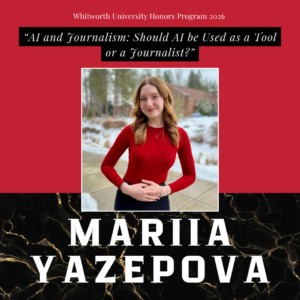
Mariia Yazepova

AI is changing more quickly than ethical norms can keep up, especially in the profession of journalism (Simon, 2024). Although AI tools increase productivity, professional journalism’s survival and credibility are at risk due to their unchecked use. The human-centered principles that support press integrity are being undermined by automated news writing, copyright violations, and algorithmic disinformation (Simon, 2024). This project will compare human-reported stories to AI-generated failures, look at the ethical consequences of generative AI in journalism, and offer solutions for responsible innovation. Raising awareness of these dangers and promoting AI integration that complements human journalists rather than replaces them are the main goals. I decided to focus on this topic because I want to work in journalism, where these developments will have a direct impact on my future writing. As someone just starting out in the industry, I’m worried about how a reliance on AI might change my field of communications, possibly decreasing chances for original writing and eroding accountability standards. However, I am aware of the advantages these tools provide when used appropriately. In order to make sure that future industry professionals like myself can have credibility and ethical storytelling in an increasingly automated media landscape, this project reflects my interest in helping find a balance where innovation supports integrity.

Read More »

Delaney Woods

DELANEY WOODS Class of 2024. Health Sciences Major.  Breaking the Cycle: Redefining healthcare through overprescription awareness In a healthcare system reliant on pharmacological interventions, patient

Read More »

Britney Lewis

The stereotype of women apologizing more than men was tested by a psychology study which found that women apologized at higher frequencies. Yet, each gender apologized for an equal proportion of their offenses if it was recognized by them as a transgression (81% mean for men and women). My question was inspired by considering the compliment to an apology, forgiveness. If women engage with apology behavior at higher frequencies, whether or not a transgression has been fully realized, does this water down their engagement with relational repair? Conversely, does a lower frequency and a higher threshold for viewing a situation as apology-worthy influence greater levels of sincerity in the interpretation of forgiveness for men?

Read More »