Megan Necochea
MEGAN NECOCHEA Megan is an undergraduate student at Whitworth University pursuing her Bachelor’s in English. She is the editor-in-chief of Script Magazine and the nonfiction editor of Rock and

MEGAN NECOCHEA Megan is an undergraduate student at Whitworth University pursuing her Bachelor’s in English. She is the editor-in-chief of Script Magazine and the nonfiction editor of Rock and
KERI RONEY & CORINNE VASILOFF Keri: Class of 2024: I am a wife and a mother of two amazing children. After 15 years of being
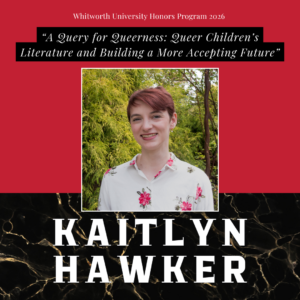
With the legalization of gay marriage in 2015, legal queer families entered the societal view. However, normalization cannot happen without positive visibility, which usually comes in the form of representation in the media society consumes. Queer characters in movies, tv shows, and adult books have appeared for decades, sometimes even centuries, but limiting queer representation to adult-only content does more harm than good. It teaches children and the culture at large that queer stories are explicit, shameful, and not appropriate.
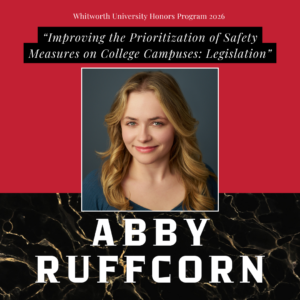
Over the past 10 years there has been a huge uptick in violence on college campuses in the United States, however, there has been no significant state or federal legislative efforts produced to work to protect students on campuses. In addition, Campus Security staff members nationwide have been overwhelmed and have been facing burnout due to lack of support from university administrators, leaving college campuses and their students vulnerable. Under the Cleary Act, nationwide, campuses have reported over 23,000 crimes on college campuses. This is a situation that has been pushed forward even more by the increase of political divisions on campuses and the prevalent nature of protests that turn unpeaceful and spark further violence. This project seeks to demonstrate the need for federal legislation that demands one professional campus security officer per two hundred students on any college campus that takes federal funding from the United States government. Currently, in the United States, there is no clear baseline/bench marker for how many campus security officers an institution needs to have. This lack of foresight leaves room for campus violence to surge. Through this project I will write a policy that institutes a required number of security officers on any campus that takes federal funding and identifies itself as a university.
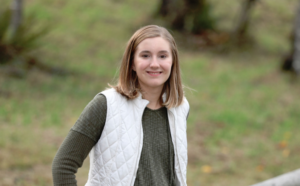
Hannah Stoddard, who is majoring in international studies, found that Honors has given her a way to connect her major, her personal experiences, and her passion. The intersection of these different parts of Hannah’s life has resulted in a pool project aimed to improve local communities.

My honors project addresses this gap by developing a sign language translator application, functioning similarly to Google Translate. The app features a keyboard that displays ASL signs as images, allowing users to either select signs directly to communicate in sign language or type words normally and have them translated into the corresponding signs. This application is built with one goal in mind: to ensure that every person, regardless of hearing ability, can communicate effectively and with dignity.
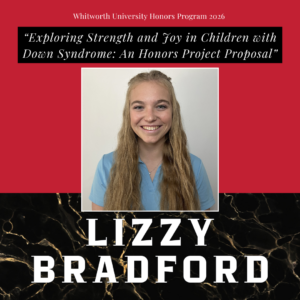
Families that have children who experience Down Syndrome are confronted with many demanding needs in order to help their child thrive in today’s society. Unfortunately, several limitations can interfere with getting help for these families who are in need of additional services including therapy for their children. This proposed project aims to decrease the disadvantages and clarify the resources and research available to them. It hopes to combat the limited access to physical therapy, by producing a social media page with extensive resources, up-to-date research, and exercise videos related to improving quality of life and development for children with Down Syndrome along with their families. What inspired my project was my interest in pediatric physical therapy as well as my close relationships with people who have Down Syndrome. I have had wonderful opportunities to volunteer at Down Syndrome Success Organizations and have learned about techniques that help further the development of children with Down Syndrome. I have seen firsthand how much joy they bring to the lives around them and how many stressors they (and their families) can encounter in everyday life. Even though I am not a licensed Physical Therapist yet, and thus can’t provide any actual therapy, I hope that my social media page will help clarify the research and resources available for families who need it.
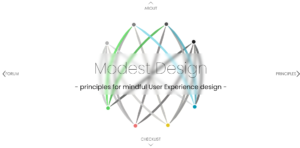
Sarah Immel, a senior double majoring in human computer interactions and English writing studies, is using the Honors program as a way to merge the different interests in her majors and design interdisciplinary projects.
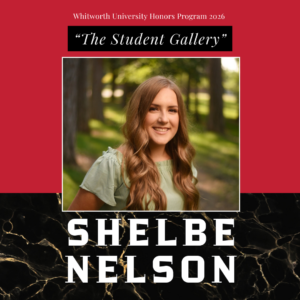
Growing up, I’ve always had an affinity towards creativity, art-hobbying, and music. They bring me joy and personal flourishing outside of my every-day life. I think that it is a large part of being human. What inspired my work is the recent conflict between social media platforms and artists. Over the recent years, the content of visual and musical artists have been subjugated to constant thieving of their work by AI and being buried due to biased media algorithms. In a time where many careers are put under threat by replacement via AI, I want to make a change, even if it is a small one. My career of studying marketing and economic tactics has taught me how to be a voice for those who need it. So I have decided to put my skills to the test and bring light to my peers even in these uncertain times.
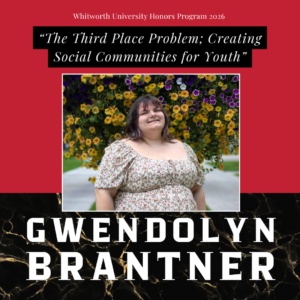
My project investigates the third place problem, a topic which has recently gained traction online in gen z communities as we try to gain some adult social life once leaving school. Third places are defined as space outside of home (1st place) and work/school (2nd place) in which individuals spend a large portion of time socializing and connecting with their community. The traditional sense of the phrase requires that third place be free to access, easy to access, and full of opportunities for social connection with those both similar and opposite to you. This topic has always interested me and I am a strong advocate for people having fulfilling social lives outside of family and outside of obligation. Considering my future career path, I focused my project on third places and youth, specifically. My project begins by investigating the reasons for the decline in third spaces in the 21st century due to cultural shifts, technological developments, and even legal constraints. Then, I present why the lack of these spaces is detrimental, particularly to youth populations ages 12-17, when it is so easy to disappear into online spaces instead. My research concludes by offering up some examples of ideal solutions for youth populations and their guardians, considering accessibility and safety concerns that many guardians have about sending children to third places. With proper support and engagement the youth programs and non-profits which offer third space solutions could be the key to maintaining the social health of younger generations despite the many barriers to finding community.
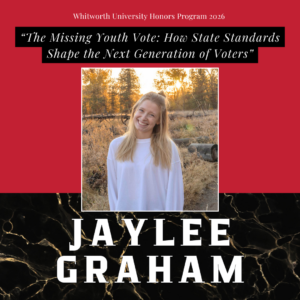
Gen Z is arguably the most politically outspoken generation in history. From social media activism to grassroots organizing, we aren’t afraid to use our voices to demand change. Yet, there’s a frustrating paradox at the heart of our democracy: despite being the most vocal, 18–24-year-olds consistently remain in the demographic with the lowest voter turnout. This project is driven by one central question: What do we actually need to do to increase young voter turnout?
I believe that education is at the root of many of the systemic problems we see in the world today. If we want to change the trajectory of our society, we have to look at where our civic identity is formed. For the vast majority of Americans, high school is the last time they will be part of a formal, universal educational environment. This makes the high school classroom our final and most critical opportunity to reach every future citizen. If we aren’t using that time to effectively teach the voting process and the importance of civic agency, we are leaving the health of our democracy to chance.
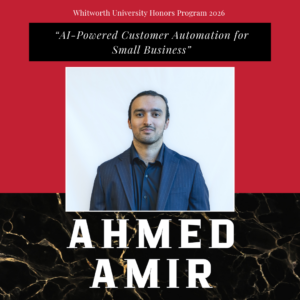
Small businesses operate under constant time pressure, often leading to missed calls. Data shows that 62% of calls to small businesses go unanswered, and 85% of those callers will not try to contact the business again. This translates to an average loss of over $126,000 in annual revenue per business. While large corporations have the budget for advanced AI communication tools, small business owners are often left behind due to high costs and technical complexity. My project aims to bridge this “tech gap” by creating a functional prototype of an AI onboarding process and dashboard tailored specifically for small business needs. My research focused on how to make sophisticated technology user-friendly; I developed an onboarding system that allows a business owner to set up a custom AI agent through simple, non-technical steps. Additionally, I built a dashboard that visualizes critical metrics such as response times, booking rates, and engagement patterns in a clear, accessible format. By simplifying the configuration and monitoring of AI, this project demonstrates how automation can reduce friction, save time, and help small businesses capture opportunities that would otherwise be lost. My goal is to prove that with the right design, cutting-edge AI can be a tool for every entrepreneur, not just those with enterprise-level budgets.
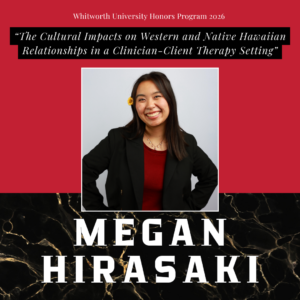
When I learned about bicultural perspectives in psychology at Massey University, I was asked to write a critical reflection about connecting the Māori concepts in psychology to my future career. As I researched previous studies and articles about Native Hawaiians for my critical reflection, I noticed that Native Hawaiian mental health research is limited, and some topics of current research include depression, health disparities, COVID, and the impacts cost of living; consequently, Native Hawaiians are often the most misrepresented in healthcare. According to McCubbin and Marsella (2009), Native Hawaiians have not only been excluded from health research but also have not been adequately supported financially when projects emphasize Native Hawaiians. Because of these systemic barriers behind research, Native Hawaiians deserve more attention in psychological research and need specific strategies on how to include their worldviews into the therapy room.
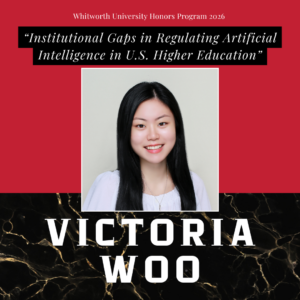
This research project examines how institutions of higher education in the United States are responding to the rapid integration of artificial intelligence tools in academic environments, and where significant regulatory gaps remain. As generative AI systems become increasingly accessible to students and faculty, universities face growing challenges in maintaining academic integrity, supporting cognitive development, and addressing algorithmic bias.
KYLE MARQUEZ Class of 2024. Political Science and Theology Majors. How to Partner for Justice: Linking Whitworth with the world through education and activism
HAILEY NASS Class of 2025. Elementary Education Major. I come from a family of teachers and have always been drawn to helping people. I am
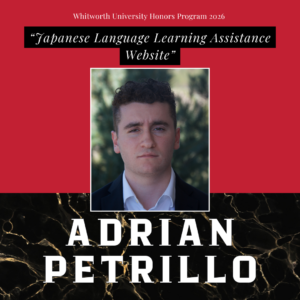
Growing up, I attended a Japanese immersion school, so I have been learning the language since I was a child. However, upon graduation without any more opportunity for classroom education, I had to turn to self-education to further my learning. This is where I discovered there was a severe lack of convenient language acquisition assistance tools for the Japanese language, and the ones that did exist were all hosted in different locations. That is the motivation for this project, where I aimed to create an all-in-one location for Japanese language learning tools to assist those partaking in self-study.
IRENE RACHARLA Class of 2024. Majoring in Computer Science on Business Track with minors in Sociology and G.W. Honors. Hosanna leader and member of Forest
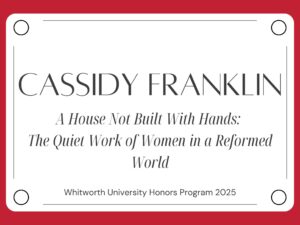
My project exists to bring glory to God and honor His creative design for men and women by mirroring the literary structure of Christine de Pizan’s The Book of the City of Ladies. In this piece of creative nonfiction, the symbolic building of a Protestant church—beautiful, unadorned, and rooted in Scripture—serves as the framework for showcasing the biblical femininity of six extraordinary women from the Protestant Reformation.
TRICIA CEBOTARI Class of 2024. Hello! I’m an undergraduate student at Whitworth University pursuing my B.A. in Computer Science International Project Management and Spanish Language/Literature,
Hannah Neuberger, a senior majoring in biology, is researching the level of polychlorinated biphenyls (PCB’s) in the Spokane River in her HN 400 class.
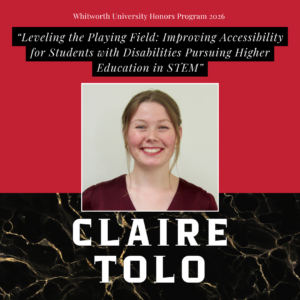
Students with disabilities (SWD) make up 17-19% of the student population in higher education institutions. However, research focused on them accounts for only 1% of papers published in education journals. Furthermore, disabled students are less likely to enroll in science, technology, mathematics and engineering (STEM) courses compared to their abled peers. Researchers have posited that this may be due to both physical barriers, such as inaccessible laboratories, and cultural ones, like negative experiences with peers and faculty. So what can universities do to improve the landscape of their STEM cohorts to make them more equitable and inclusive for students with disabilities? Existing research has suggested a variety of solutions, ranging from implementing Universal Design Learning (UDL) to purchasing specialized lab equipment. But there does not yet exist a compilation of the current recommendations for interventions and best practice for improving equity and accessibility in STEM departments. In this project, I will examine the specific challenges faced by SWD in the classroom and laboratory, interventions to improve challenges faced, and practical suggestions institutions can utilize to effectively implement the interventions in their STEM programs.
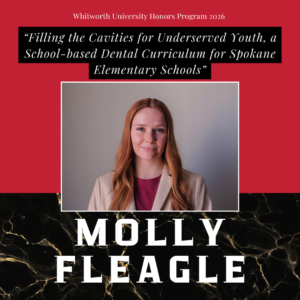
Access to affordable and preventive dental care remains a significant challenge in Spokane, Washington, particularly for children in low-income, minority, and non-English-speaking families. Many residents with Apple Health coverage, the dental care insurance for low-income families, still face barriers to treatment due to limited provider participation and low reimbursement rates. Compounding these disparities, Spokane is the largest city in Washington that has not implemented water fluoridation, contributing to higher rates of untreated tooth decay among children. This project seeks to address these oral health inequities by developing a proposal advocating for school-based preventive dental programs and curricula, specifically brushing techniques, the truth about cavities, and demonstrations in Spokane’s low-income elementary schools. Ultimately, this work seeks to improve equitable access to dental care for Spokane’s children and contribute to long-term community health outcomes.
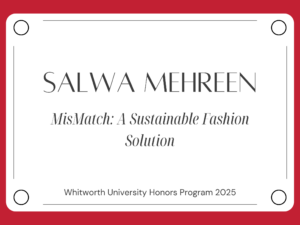
My project, MisMatch, started from a real-life frustration — how much time and energy it takes just to pick an outfit. Research shows that people spend around 102 hours a year deciding what to wear (Marks & Spencer), and about 50% of Americans say it’s the most stressful part of getting ready for an event (Trunk Club). At the same time, the fast fashion industry produces around 92 million tons of textile waste each year (UNEP), most of which ends up in landfills. I wanted to create something that helped people in their everyday lives while also promoting more sustainable habits.
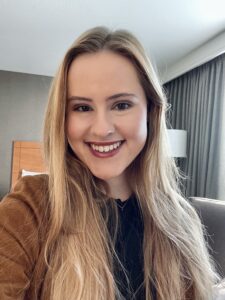
Grace Pedersen, a senior majoring in psychology, used HN 400 as a platform to launch her future. HN 400 gives students the ability to complete an individual project with faculty support and guidance.
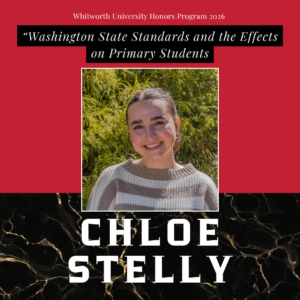
Since going through the Education Department here at Whitworth, I have become increasingly interested in the academic achievement of our students here in Washinton. Education has changed so drastically over the years, and the hope is that we are still meeting the needs of our students in an ever-shifting society. Since Covid, state testing has dropped and has continued to do so which raises concern; how can our children get the best education when standards are so demanding? Is the education we are providing right now the education our students need? I wanted to study the effects that state standards have on primary children and whether or not an increase in academic performance is happening in our schools. The reason for this project is to study the impact of our state standards on the growth and development of our students.