Honors Capstone Projects

Video made with the assistance of Samuel Ortega ’25

All George Whitworth Honors students complete an individual project as part of their Honors Curriculum, cultivating skills of problem-solving, project proposals, and project management.


Projects may be academic or applied but in some way reflect the Honors Program’s Mission:


The Whitworth Honors Program challenges talented and motivated scholars to pursue excellence of mind and heart, to cultivate leadership qualities and skills, and to commit to lives of service. The Honors Program does more than guide scholars to navigate the world as it is; it equips them to solve problems and to develop the world as it should be.”

Click the links below to get a sense of what students have been doing!

Emma Maple

EMMA MAPLE Class of 2024. Communication Studies and Political Science Major.  The Case of the Missing Context: Newspaper coverage of the Supreme Court’s decisions in

Read More »

Jacob Soo

One of the main reasons that kids quit sports is because of poor coaching. When coaches are hired, they are often not properly trained. This project aims to fill a gap in the research when it comes to youth sports coaching and training and can be a valuable piece for coaching journals and local athletic associations. This project also sheds light on how youth sports coaches could be more comprehensively trained and can be valuable to any parent seeking a better athletic experience for their child. This project does not only focus on the basic skills needed for youth sports coaches, like CPR and first aid, but also on more complex skills like emotional control and creating an inclusive space for young athletes.

Read More »

Megan Hirasaki

When I learned about bicultural perspectives in psychology at Massey University, I was asked to write a critical reflection about connecting the Māori concepts in psychology to my future career. As I researched previous studies and articles about Native Hawaiians for my critical reflection, I noticed that Native Hawaiian mental health research is limited, and some topics of current research include depression, health disparities, COVID, and the impacts cost of living; consequently, Native Hawaiians are often the most misrepresented in healthcare. According to McCubbin and Marsella (2009), Native Hawaiians have not only been excluded from health research but also have not been adequately supported financially when projects emphasize Native Hawaiians. Because of these systemic barriers behind research, Native Hawaiians deserve more attention in psychological research and need specific strategies on how to include their worldviews into the therapy room.

Read More »

Margaret Byle

As a Christian in the science field, these two dominant fields have always been a big part of my learning and worldview. During our time at Cambridge, we read a book by Yuval Harari titled Sapeins. In this book, Yuval Harari is attempting to tell the story of science throughout human history. I observed that in this attempt, Harari is guilty of placing science in a bubble, ignoring big changes going on in the world, specifically around the Scientific Revolution. This realization, paired with my strong passion and fascination for science and religion, led me to desire to be able to better prove that these two fields are not in conflict.

Read More »

Molly Fleagle

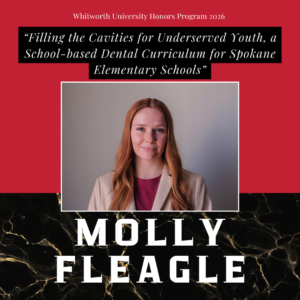
Access to affordable and preventive dental care remains a significant challenge in Spokane, Washington, particularly for children in low-income, minority, and non-English-speaking families. Many residents with Apple Health coverage, the dental care insurance for low-income families, still face barriers to treatment due to limited provider participation and low reimbursement rates. Compounding these disparities, Spokane is the largest city in Washington that has not implemented water fluoridation, contributing to higher rates of untreated tooth decay among children. This project seeks to address these oral health inequities by developing a proposal advocating for school-based preventive dental programs and curricula, specifically brushing techniques, the truth about cavities, and demonstrations in Spokane’s low-income elementary schools. Ultimately, this work seeks to improve equitable access to dental care for Spokane’s children and contribute to long-term community health outcomes.

Read More »

Jaylee Graham

Gen Z is arguably the most politically outspoken generation in history. From social media activism to grassroots organizing, we aren’t afraid to use our voices to demand change. Yet, there’s a frustrating paradox at the heart of our democracy: despite being the most vocal, 18–24-year-olds consistently remain in the demographic with the lowest voter turnout. This project is driven by one central question: What do we actually need to do to increase young voter turnout?
I believe that education is at the root of many of the systemic problems we see in the world today. If we want to change the trajectory of our society, we have to look at where our civic identity is formed. For the vast majority of Americans, high school is the last time they will be part of a formal, universal educational environment. This makes the high school classroom our final and most critical opportunity to reach every future citizen. If we aren’t using that time to effectively teach the voting process and the importance of civic agency, we are leaving the health of our democracy to chance.

Read More »

Melinda Mullet

Aging Americans and their caregivers should have easy access to dignifying end-of-life care. The rapid increase in the 65+ population requires policy innovation in current Medicare regulation concerning hospice. Coordinated, intentional efforts between government and private sector providers, insurance navigators, community organizations, and houses of worship are also needed to change public attitudes towards hospice care, encourage referrals, increase uptake, and offer emotional, psychological, and spiritual support.

Read More »

Hannah Cordero-Johnson

Immigration has long been a contentious issue in the U.S., but recent years have seen increasingly negative public attitudes shaped by race, religion, politics, and nationalism. Notably, research shows that white evangelical Christians often support restrictive immigration policies—despite professing compassion and a biblical call to welcome the stranger. This study explores how those contradictions play out locally in Spokane, Washington, by centering the voices of immigrants and refugees and examining how race, religion, and legal status shape their resettlement experiences.

Read More »

Delaney Woods

DELANEY WOODS Class of 2024. Health Sciences Major.  Breaking the Cycle: Redefining healthcare through overprescription awareness In a healthcare system reliant on pharmacological interventions, patient

Read More »

Adrian Petrillo

Growing up, I attended a Japanese immersion school, so I have been learning the language since I was a child. However, upon graduation without any more opportunity for classroom education, I had to turn to self-education to further my learning. This is where I discovered there was a severe lack of convenient language acquisition assistance tools for the Japanese language, and the ones that did exist were all hosted in different locations. That is the motivation for this project, where I aimed to create an all-in-one location for Japanese language learning tools to assist those partaking in self-study.

Read More »

Lizzie Berns

My research is specifically looking at Whitworth and how they treat sexual violence on campus. I looked into what resources and programs there are for sexual violence survivors on this campus or any education about what sexual violence is for the rest of the student body. What I found was scarce, not only the research around Christian colleges and sexual assault, but also the resources on this campus for students.

Read More »

Abby Ruffcorn

Over the past 10 years there has been a huge uptick in violence on college campuses in the United States, however, there has been no significant state or federal legislative efforts produced to work to protect students on campuses. In addition, Campus Security staff members nationwide have been overwhelmed and have been facing burnout due to lack of support from university administrators, leaving college campuses and their students vulnerable. Under the Cleary Act, nationwide, campuses have reported over 23,000 crimes on college campuses. This is a situation that has been pushed forward even more by the increase of political divisions on campuses and the prevalent nature of protests that turn unpeaceful and spark further violence. This project seeks to demonstrate the need for federal legislation that demands one professional campus security officer per two hundred students on any college campus that takes federal funding from the United States government. Currently, in the United States, there is no clear baseline/bench marker for how many campus security officers an institution needs to have. This lack of foresight leaves room for campus violence to surge. Through this project I will write a policy that institutes a required number of security officers on any campus that takes federal funding and identifies itself as a university. 

Read More »

Noran Khalil

My honors project addresses this gap by developing a sign language translator application, functioning similarly to Google Translate. The app features a keyboard that displays ASL signs as images, allowing users to either select signs directly to communicate in sign language or type words normally and have them translated into the corresponding signs. This application is built with one goal in mind: to ensure that every person, regardless of hearing ability, can communicate effectively and with dignity.

Read More »

Gwendolyn Brantner

My project investigates the third place problem, a topic which has recently gained traction online in gen z communities as we try to gain some adult social life once leaving school. Third places are defined as space outside of home (1st place) and work/school (2nd place) in which individuals spend a large portion of time socializing and connecting with their community. The traditional sense of the phrase requires that third place be free to access, easy to access, and full of opportunities for social connection with those both similar and opposite to you. This topic has always interested me and I am a strong advocate for people having fulfilling social lives outside of family and outside of obligation. Considering my future career path, I focused my project on third places and youth, specifically. My project begins by investigating the reasons for the decline in third spaces in the 21st century due to cultural shifts, technological developments, and even legal constraints. Then, I present why the lack of these spaces is detrimental, particularly to youth populations ages 12-17, when it is so easy to disappear into online spaces instead. My research concludes by offering up some examples of ideal solutions for youth populations and their guardians, considering accessibility and safety concerns that many guardians have about sending children to third places. With proper support and engagement the youth programs and non-profits which offer third space solutions could be the key to maintaining the social health of younger generations despite the many barriers to finding community.

Read More »