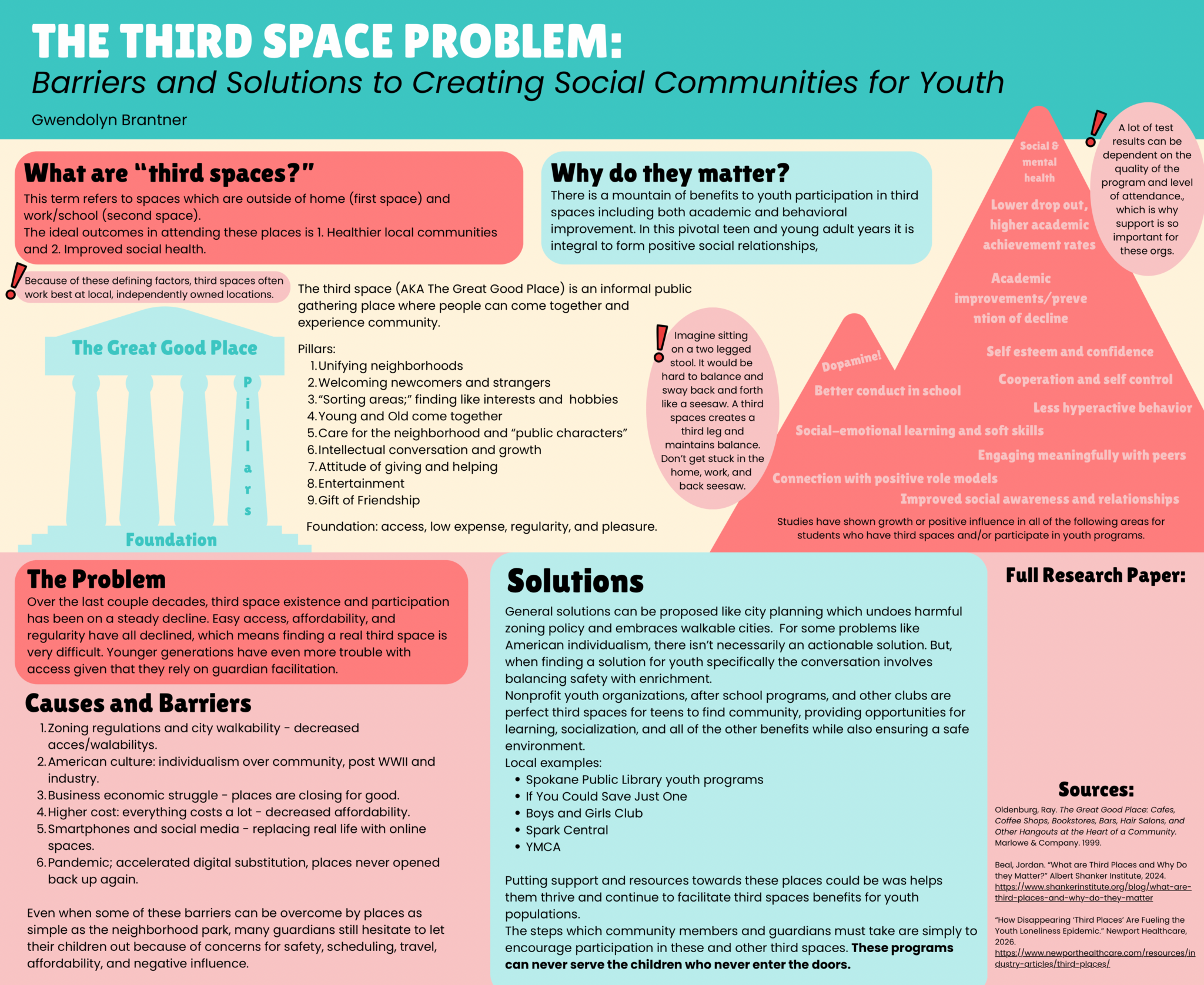
The Third Place Problem; Creating Social Communities for Youth
Gwendolyn Brantner

MAJOR: English
Minors: Dance & Art
BIO: I am from Omak, Washington. In my time at Whitworth I have participated in clubs like Jubilation Dance Ministry, Cool Whip Improv Comedy Club, and Storytellers Club. I am also a member of Sigma Tau Delta English honors society. I work with the Whitworth admissions office and the Associated Students of Whitworth University. After getting my BA in English at Whitworth I’m going to pursue my master’s in secondary education. I plan to teach at rural schools like my high school and put efforts towards creative writing programs. I also intend to get a job as an instructor at a dance company to continue my performing arts career.
Project Overview: My project investigates the third place problem, a topic which has recently gained traction online in gen z communities as we try to gain some adult social life once leaving school. Third places are defined as space outside of home (1st place) and work/school (2nd place) in which individuals spend a large portion of time socializing and connecting with their community. The traditional sense of the phrase requires that third place be free to access, easy to access, and full of opportunities for social connection with those both similar and opposite to you. This topic has always interested me and I am a strong advocate for people having fulfilling social lives outside of family and outside of obligation. Considering my future career path, I focused my project on third places and youth, specifically. My project begins by investigating the reasons for the decline in third spaces in the 21st century due to cultural shifts, technological developments, and even legal constraints. Then, I present why the lack of these spaces is detrimental, particularly to youth populations ages 12-17, when it is so easy to disappear into online spaces instead. My research concludes by offering up some examples of ideal solutions for youth populations and their guardians, considering accessibility and safety concerns that many guardians have about sending children to third places. With proper support and engagement the youth programs and non-profits which offer third space solutions could be the key to maintaining the social health of younger generations despite the many barriers to finding community.