Honors Life at Whitworth

Recent:

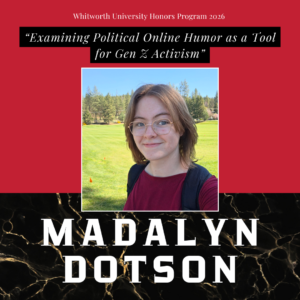
Madalyn Dotson

In September of 2025, youth and Gen-Z individuals in Nepal overthrew their corrupt government through a series of protests and riots. They voted for their interim prime minister through Discord, and throughout the protests, the world saw Gen-Z laughing and joking their way through a major historical event. Gen-Z has been nicknamed the “unserious generation”, but in Nepal they also led the movement that led to a significant change in government. This begs the question of how this will inspire other Gen-Z protestors and activists across the world. How does Gen-Z view violence as an actor for change? Do they use humor as a tool, strategy, or a way to cope? How necessary is humor for Gen-Z’s activism? In my academic project, I explored these questions by looking at a variety of examples all over the world, with a focus on Nepal. As someone who is Gen Z, loves memes and humor, and is interested in political activism, I think that this project is important to see how young people are actively changing the world around them.
Read More »

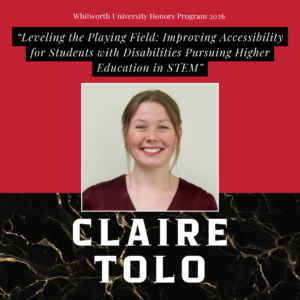
Claire Tolo

Students with disabilities (SWD) make up 17-19% of the student population in higher education institutions. However, research focused on them accounts for only 1% of papers published in education journals. Furthermore, disabled students are less likely to enroll in science, technology, mathematics and engineering (STEM) courses compared to their abled peers. Researchers have posited that this may be due to both physical barriers, such as inaccessible laboratories, and cultural ones, like negative experiences with peers and faculty. So what can universities do to improve the landscape of their STEM cohorts to make them more equitable and inclusive for students with disabilities? Existing research has suggested a variety of solutions, ranging from implementing Universal Design Learning (UDL) to purchasing specialized lab equipment. But there does not yet exist a compilation of the current recommendations for interventions and best practice for improving equity and accessibility in STEM departments. In this project, I will examine the specific challenges faced by SWD in the classroom and laboratory, interventions to improve challenges faced, and practical suggestions institutions can utilize to effectively implement the interventions in their STEM programs.

Read More »

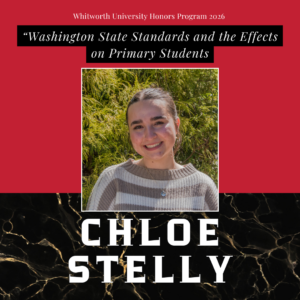
Chloe Stelly

Since going through the Education Department here at Whitworth, I have become increasingly interested in the academic achievement of our students here in Washinton. Education has changed so drastically over the years, and the hope is that we are still meeting the needs of our students in an ever-shifting society. Since Covid, state testing has dropped and has continued to do so which raises concern; how can our children get the best education when standards are so demanding? Is the education we are providing right now the education our students need? I wanted to study the effects that state standards have on primary children and whether or not an increase in academic performance is happening in our schools. The reason for this project is to study the impact of our state standards on the growth and development of our students.

Read More »

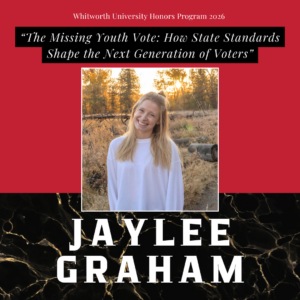
Jaylee Graham

Gen Z is arguably the most politically outspoken generation in history. From social media activism to grassroots organizing, we aren’t afraid to use our voices to demand change. Yet, there’s a frustrating paradox at the heart of our democracy: despite being the most vocal, 18–24-year-olds consistently remain in the demographic with the lowest voter turnout. This project is driven by one central question: What do we actually need to do to increase young voter turnout?
I believe that education is at the root of many of the systemic problems we see in the world today. If we want to change the trajectory of our society, we have to look at where our civic identity is formed. For the vast majority of Americans, high school is the last time they will be part of a formal, universal educational environment. This makes the high school classroom our final and most critical opportunity to reach every future citizen. If we aren’t using that time to effectively teach the voting process and the importance of civic agency, we are leaving the health of our democracy to chance.

Read More »

Upcoming Opprotunities:

The Pursuit of a More Perfect Union

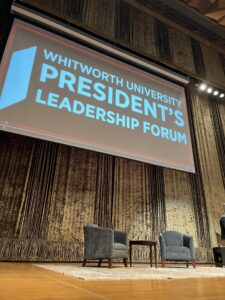
On October 14th, Jon Meacham visited Whitworth at President McQuilken’s 2026 Presidential Leadership Forum, this year hosted at the Fox Theatre. I attended his evening talk at the Fox called, “American Struggle: Democracy, Dissent, and the Pursuit of a More Perfect Union,” a nod to the title of his most recent book published earlier this year.

Read More »

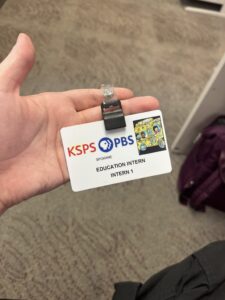
Micro-Internship: KSPS PBS LearningMedia

The KSPS PBS micro-internship is focused on their online educational content. PBS has a learning platform called PBS LearningMedia where any station from across the country can upload lessons, videos, and teaching tools for free use by teachers and students. KSPS is one of the stations that contributes material, but they’ve become increasingly aware that the material currently up isn’t as robust as it could be.

Read More »

Whitworth Launch

We are proud to announce that micro-internships, mentors, and upcoming professionalization events now have a home on the Whitworth Launch website. This site hosts the applications and internship postings, connecting you directly with the people who want to give you a job.

Read More »

Fall 26 Speakers

Fall 26 Speakers Jon Meacham Meghan Sullivan Dr. Robert George Dr. Cornel West October 14th: Jon Meacham “American Struggle: Democracy, Dissent, and the Pursuit of

Read More »

Internships:

Summers Capturing Lilacs

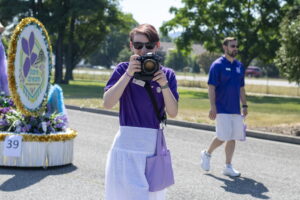
Some people go to the lake, some people pick up extra shifts, and some spend hours tanning in the sun. Me? I spend my summer Saturdays attending regional festivals and parades with the Spokane Lilac Festival.

Read More »

Micro-Internship: KSPS PBS LearningMedia

The KSPS PBS micro-internship is focused on their online educational content. PBS has a learning platform called PBS LearningMedia where any station from across the country can upload lessons, videos, and teaching tools for free use by teachers and students. KSPS is one of the stations that contributes material, but they’ve become increasingly aware that the material currently up isn’t as robust as it could be.

Read More »

Whitworth Launch

We are proud to announce that micro-internships, mentors, and upcoming professionalization events now have a home on the Whitworth Launch website. This site hosts the applications and internship postings, connecting you directly with the people who want to give you a job.

Read More »

On-Campus Spotlights:

Honors senior works to improve pool access

Hannah Stoddard, who is majoring in international studies, found that Honors has given her a way to connect her major, her personal experiences, and her passion. The intersection of these different parts of Hannah’s life has resulted in a pool project aimed to improve local communities.

Read More »

HN 400 as a Platform for the Future

Grace Pedersen, a senior majoring in psychology, used HN 400 as a platform to launch her future. HN 400 gives students the ability to complete an individual project with faculty support and guidance.

Read More »

“We all started crying, of course”

Every year during the Spring semester, Whitworth hosts a few Honors scholarship weekends. These weekends are times in which highly motivated students are invited to stay at Whitworth. During the weekend, the invited students give a speech, participate in a discussion group, and write an essay in hopes of winning a full ride scholarship or a runner-up $1,000 a year scholarship. This year, one of the full-ride scholarship winners is eighteen year old Stella Ester Palmisano.

Read More »

Study Abroad:

Our Visit to the Bishop Museum

On the 2026 Honors Hawaii Jan term trip, we had the opportunity to visit the Bishop Museum. The Bishop Museum is located in sunny Honolulu and is the official Museum of Natural and Cultural History of Hawaii. Here we had the joy of exploring several fascinating exhibits, including sections devoted to Hawaiian and Polynesian history, natural science, and even dinosaurs!

Read More »

Experiencing the Theatre in London

Over the course of the 2026 Jan term trip to London I had the privilege of attending nine different stage productions, all very different, but all equally valuable to my experience studying abroad. It was an opportunity I had never had before to be able to go somewhere where dozens of shows of West End quality were all playing at the same time. I bought as many tickets as I reasonably could with my budget and aimed to get the maximum value out of each show I saw. Over the course of the trip, I gained a renewed appreciation for the performance arts and their value, not only to British culture, but society in general.

Read More »

Wahiawā Botanical Gardens: The Art and Tradition of Lei Making

At the Wahiawā Botanical Gardens, the practice of lei making is taught to visitors, both to carry on the tradition and teach the significance of the weave to visitors, but also to aid in the onerous task of weaving approximately 53,000 lei for Memorial Day. The Wahiawā Botanical Gardens contributes 7,000 natural lei every year to the project. In the hour and a half the Whitworth students were there, we made one hundred woven Ti lei. Hundreds of organizations run similar lei making sessions for the five months leading up to Memorial Day, freezing the lei braids to keep them until May.

Read More »

Haoles in Hawaii: Trip to the Polynesian Culture Center

On the 5th day of the First Year Honors group’s stay in Hawaii, we visited the Polynesian Cultural Center. After a long, sun drenched day full of information, performances, and beautiful scenery, most of us came away with a deeper understanding of Polynesian culture and the complex traditions preserved in places like the PCC (Polynesian Cultural Center).

Read More »

Research:

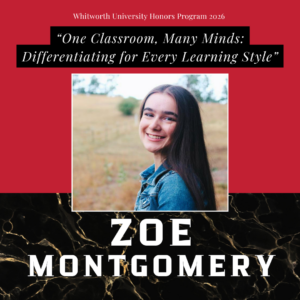
Zoe Montgomery

I have always had a passion for understanding learning styles and differentiating instruction based on those styles. Throughout my own education, I have been aware that I am a visual learner, which has helped me choose learning and study habits best suited for me. As a future elementary school teacher, I wanted to explore how teachers can better teach to various learning styles in their classrooms. I believe that we can increase the success of our students when we plan our classrooms and lessons with their learning styles in mind. Building differentiation for learning styles into lesson plans can allow students to engage in the content in the way that best suits them. When I came up with the idea for this project, I wanted to learn more about the improvements teachers can make and why they should make them. One conclusion that I have come upon is that this can be a time-consuming process, though a worthwhile one. When lessons are planned around learning styles, students are more engaged because the content feels more accessible to them. Students also become more able to grasp complex concepts because the information is presented in multiple ways. Among the many other benefits, learning style modifications are a great way to support diverse learners. My project aims to inform my future teaching and educate others on the importance of planning a classroom with learning styles in mind.

Read More »

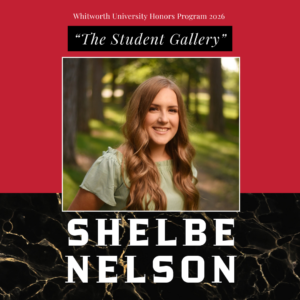
Shelbe Nelson

Growing up, I’ve always had an affinity towards creativity, art-hobbying, and music. They bring me joy and personal flourishing outside of my every-day life. I think that it is a large part of being human. What inspired my work is the recent conflict between social media platforms and artists. Over the recent years, the content of visual and musical artists have been subjugated to constant thieving of their work by AI and being buried due to biased media algorithms. In a time where many careers are put under threat by replacement via AI, I want to make a change, even if it is a small one. My career of studying marketing and economic tactics has taught me how to be a voice for those who need it. So I have decided to put my skills to the test and bring light to my peers even in these uncertain times.

Read More »

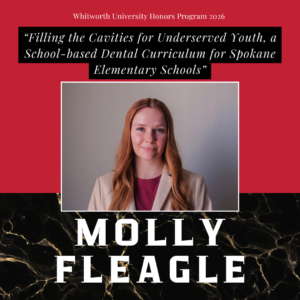
Molly Fleagle

Access to affordable and preventive dental care remains a significant challenge in Spokane, Washington, particularly for children in low-income, minority, and non-English-speaking families. Many residents with Apple Health coverage, the dental care insurance for low-income families, still face barriers to treatment due to limited provider participation and low reimbursement rates. Compounding these disparities, Spokane is the largest city in Washington that has not implemented water fluoridation, contributing to higher rates of untreated tooth decay among children. This project seeks to address these oral health inequities by developing a proposal advocating for school-based preventive dental programs and curricula, specifically brushing techniques, the truth about cavities, and demonstrations in Spokane’s low-income elementary schools. Ultimately, this work seeks to improve equitable access to dental care for Spokane’s children and contribute to long-term community health outcomes.

Read More »

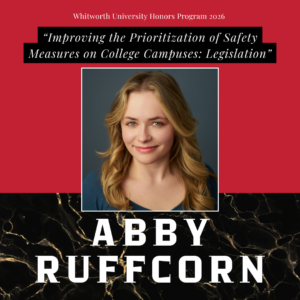
Abby Ruffcorn

Over the past 10 years there has been a huge uptick in violence on college campuses in the United States, however, there has been no significant state or federal legislative efforts produced to work to protect students on campuses. In addition, Campus Security staff members nationwide have been overwhelmed and have been facing burnout due to lack of support from university administrators, leaving college campuses and their students vulnerable. Under the Cleary Act, nationwide, campuses have reported over 23,000 crimes on college campuses. This is a situation that has been pushed forward even more by the increase of political divisions on campuses and the prevalent nature of protests that turn unpeaceful and spark further violence. This project seeks to demonstrate the need for federal legislation that demands one professional campus security officer per two hundred students on any college campus that takes federal funding from the United States government. Currently, in the United States, there is no clear baseline/bench marker for how many campus security officers an institution needs to have. This lack of foresight leaves room for campus violence to surge. Through this project I will write a policy that institutes a required number of security officers on any campus that takes federal funding and identifies itself as a university. 

Read More »