Jillian Whiting
Ultimately, my project seeks to foster a more informed healthcare environment. One in which researchers, healthcare professionals, and patients are better equipped to navigate the unique complexities of women’s health.

Ultimately, my project seeks to foster a more informed healthcare environment. One in which researchers, healthcare professionals, and patients are better equipped to navigate the unique complexities of women’s health.
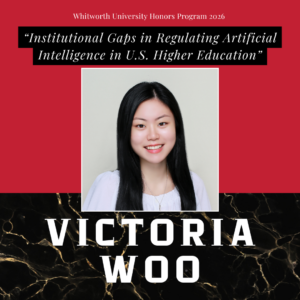
This research project examines how institutions of higher education in the United States are responding to the rapid integration of artificial intelligence tools in academic environments, and where significant regulatory gaps remain. As generative AI systems become increasingly accessible to students and faculty, universities face growing challenges in maintaining academic integrity, supporting cognitive development, and addressing algorithmic bias.
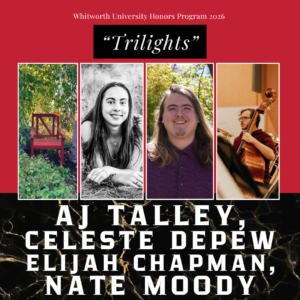
Trilights is an interactive video game that focuses on character and storytelling, aiming to present a new synthesis between the literary and the ludomechanical (game-playing). As an interdisciplinary project, Trilights allows a further exploration of the possibilities of creative writing, acoustic arts, artistic expression, and well-designed programming.
MEGAN NECOCHEA Megan is an undergraduate student at Whitworth University pursuing her Bachelor’s in English. She is the editor-in-chief of Script Magazine and the nonfiction editor of Rock and
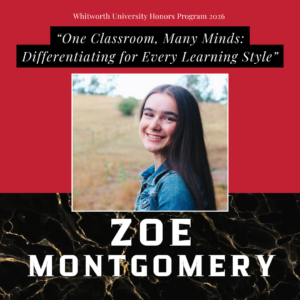
I have always had a passion for understanding learning styles and differentiating instruction based on those styles. Throughout my own education, I have been aware that I am a visual learner, which has helped me choose learning and study habits best suited for me. As a future elementary school teacher, I wanted to explore how teachers can better teach to various learning styles in their classrooms. I believe that we can increase the success of our students when we plan our classrooms and lessons with their learning styles in mind. Building differentiation for learning styles into lesson plans can allow students to engage in the content in the way that best suits them. When I came up with the idea for this project, I wanted to learn more about the improvements teachers can make and why they should make them. One conclusion that I have come upon is that this can be a time-consuming process, though a worthwhile one. When lessons are planned around learning styles, students are more engaged because the content feels more accessible to them. Students also become more able to grasp complex concepts because the information is presented in multiple ways. Among the many other benefits, learning style modifications are a great way to support diverse learners. My project aims to inform my future teaching and educate others on the importance of planning a classroom with learning styles in mind.
EMMA MAPLE Class of 2024. Communication Studies and Political Science Major. The Case of the Missing Context: Newspaper coverage of the Supreme Court’s decisions in
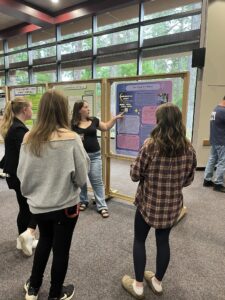
A core part of the Honors Program here at Whitworth is our final capstone project.
HAILEY NASS Class of 2025. Elementary Education Major. I come from a family of teachers and have always been drawn to helping people. I am
DELANEY WOODS Class of 2024. Health Sciences Major. Breaking the Cycle: Redefining healthcare through overprescription awareness In a healthcare system reliant on pharmacological interventions, patient
Immigration has long been a contentious issue in the U.S., but recent years have seen increasingly negative public attitudes shaped by race, religion, politics, and nationalism. Notably, research shows that white evangelical Christians often support restrictive immigration policies—despite professing compassion and a biblical call to welcome the stranger. This study explores how those contradictions play out locally in Spokane, Washington, by centering the voices of immigrants and refugees and examining how race, religion, and legal status shape their resettlement experiences.
MICHAEL ST. MARIE Class of 2024. Theology Major, English Minor. Next stop: attending Western Theological Seminary in Holland, MI next fall to pursue an M.Div.
ELEANOR JEFFERS Class of 2024. Philosophy Major. Details Forthcoming. Care Ethics for the Recently Deceased My project will analyze how an ethic of care can
My research is specifically looking at Whitworth and how they treat sexual violence on campus. I looked into what resources and programs there are for sexual violence survivors on this campus or any education about what sexual violence is for the rest of the student body. What I found was scarce, not only the research around Christian colleges and sexual assault, but also the resources on this campus for students.
ANGELA WESSEL Class of 2024. I am currently pursuing a B.B.A., with a management concentration. I also have theology and sociology minors, and career-wise I’m
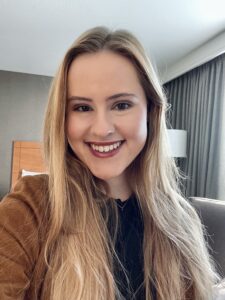
Grace Pedersen, a senior majoring in psychology, used HN 400 as a platform to launch her future. HN 400 gives students the ability to complete an individual project with faculty support and guidance.
ISABELLE SCOTTLIND Class of 2024. Isabelle is an undergraduate student at Whitworth University pursing her Bachelor’s in English and History. She hopes to pursue a
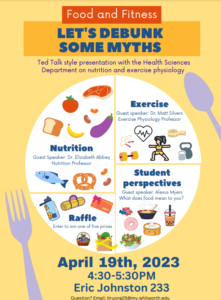
Jade Truong, a senior who is majoring in health sciences, is using Honors to connect with the community by hosting an teaching event about personal nutrition and exercise.
As a Christian in the science field, these two dominant fields have always been a big part of my learning and worldview. During our time at Cambridge, we read a book by Yuval Harari titled Sapeins. In this book, Yuval Harari is attempting to tell the story of science throughout human history. I observed that in this attempt, Harari is guilty of placing science in a bubble, ignoring big changes going on in the world, specifically around the Scientific Revolution. This realization, paired with my strong passion and fascination for science and religion, led me to desire to be able to better prove that these two fields are not in conflict.
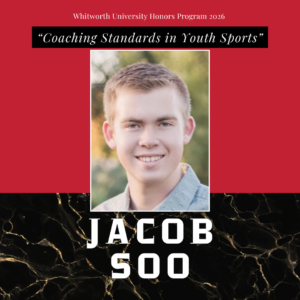
One of the main reasons that kids quit sports is because of poor coaching. When coaches are hired, they are often not properly trained. This project aims to fill a gap in the research when it comes to youth sports coaching and training and can be a valuable piece for coaching journals and local athletic associations. This project also sheds light on how youth sports coaches could be more comprehensively trained and can be valuable to any parent seeking a better athletic experience for their child. This project does not only focus on the basic skills needed for youth sports coaches, like CPR and first aid, but also on more complex skills like emotional control and creating an inclusive space for young athletes.
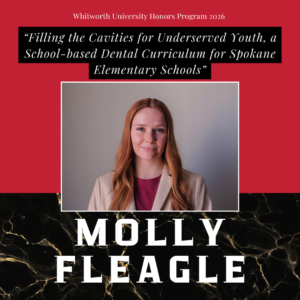
Access to affordable and preventive dental care remains a significant challenge in Spokane, Washington, particularly for children in low-income, minority, and non-English-speaking families. Many residents with Apple Health coverage, the dental care insurance for low-income families, still face barriers to treatment due to limited provider participation and low reimbursement rates. Compounding these disparities, Spokane is the largest city in Washington that has not implemented water fluoridation, contributing to higher rates of untreated tooth decay among children. This project seeks to address these oral health inequities by developing a proposal advocating for school-based preventive dental programs and curricula, specifically brushing techniques, the truth about cavities, and demonstrations in Spokane’s low-income elementary schools. Ultimately, this work seeks to improve equitable access to dental care for Spokane’s children and contribute to long-term community health outcomes.
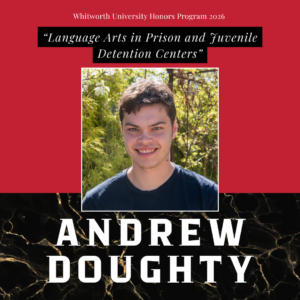
This project had two facets: one was working with the Books to Prisoners organization to put on a book drive. Through this drive we collected over 200 books which will be mailed to prisoners across the country as well as a grant for 500$ from the Sigma Tau Delta Honor society as a part of the Chapter service project to provide them with new shelving, postage, and specifically requested books. This meets a physical demand: access to the books prisoners want to read.
The other aspect of this project was volunteering in the Juvenile Detention Center in downtown Spokane where I was able to work with high school students in their English classes through creative writing workshops. I was able to connect with individual students who come from a variety of situations and use the tools I’ve learned about creative writing to help them to process and create though creative writing of their own.
REESHIKA SHARMA Class of 2024. Political Science Major. Empowering Reentry: A Look at Resources and Challenges Support for the successful reintegration of ex-offenders into society
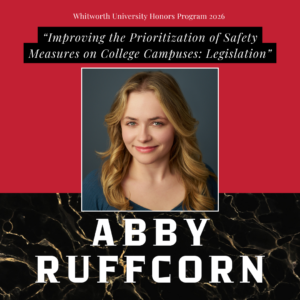
Over the past 10 years there has been a huge uptick in violence on college campuses in the United States, however, there has been no significant state or federal legislative efforts produced to work to protect students on campuses. In addition, Campus Security staff members nationwide have been overwhelmed and have been facing burnout due to lack of support from university administrators, leaving college campuses and their students vulnerable. Under the Cleary Act, nationwide, campuses have reported over 23,000 crimes on college campuses. This is a situation that has been pushed forward even more by the increase of political divisions on campuses and the prevalent nature of protests that turn unpeaceful and spark further violence. This project seeks to demonstrate the need for federal legislation that demands one professional campus security officer per two hundred students on any college campus that takes federal funding from the United States government. Currently, in the United States, there is no clear baseline/bench marker for how many campus security officers an institution needs to have. This lack of foresight leaves room for campus violence to surge. Through this project I will write a policy that institutes a required number of security officers on any campus that takes federal funding and identifies itself as a university.
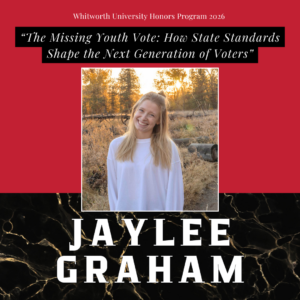
Gen Z is arguably the most politically outspoken generation in history. From social media activism to grassroots organizing, we aren’t afraid to use our voices to demand change. Yet, there’s a frustrating paradox at the heart of our democracy: despite being the most vocal, 18–24-year-olds consistently remain in the demographic with the lowest voter turnout. This project is driven by one central question: What do we actually need to do to increase young voter turnout?
I believe that education is at the root of many of the systemic problems we see in the world today. If we want to change the trajectory of our society, we have to look at where our civic identity is formed. For the vast majority of Americans, high school is the last time they will be part of a formal, universal educational environment. This makes the high school classroom our final and most critical opportunity to reach every future citizen. If we aren’t using that time to effectively teach the voting process and the importance of civic agency, we are leaving the health of our democracy to chance.
Sarah Immel, a senior double majoring in human computer interactions and English writing studies, is using the Honors program as a way to merge the different interests in her majors and design interdisciplinary projects.
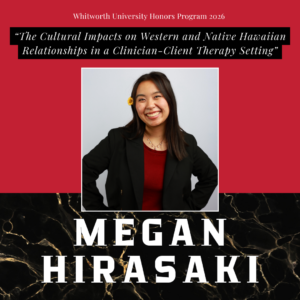
When I learned about bicultural perspectives in psychology at Massey University, I was asked to write a critical reflection about connecting the Māori concepts in psychology to my future career. As I researched previous studies and articles about Native Hawaiians for my critical reflection, I noticed that Native Hawaiian mental health research is limited, and some topics of current research include depression, health disparities, COVID, and the impacts cost of living; consequently, Native Hawaiians are often the most misrepresented in healthcare. According to McCubbin and Marsella (2009), Native Hawaiians have not only been excluded from health research but also have not been adequately supported financially when projects emphasize Native Hawaiians. Because of these systemic barriers behind research, Native Hawaiians deserve more attention in psychological research and need specific strategies on how to include their worldviews into the therapy room.