Green World Coffee Farm

Haylee Norris
Every day, an average of 2.25 billion cups of coffee are consumed across the world, and while Hawaiian grown coffee beans account for less than 1 percent of annual United States coffee consumption, the state still takes great pride in their coffee production.
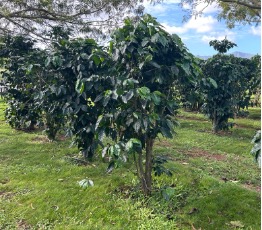
Tucked deep inside the Island of Oahu lies a coffee farm known as Green World Coffee Farm, located in Wahiawa, HI. Green World offers a variety of amenities, including a coffee farm, espresso bar, farm tours, and a retail location. On their seven-acre property, they grow and harvest two types of beans: Kona Typica and Red Catuai. Visitors are able to sample these two coffees on site anytime while the retail location is open.
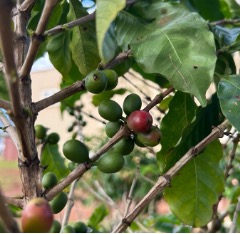
The coffee grown at Green World comes from Coffea Arabica, a plant in the Rubiaceae family, commonly known as the coffee madder or bedstraw family. These tropical plants originated in Africa and take time and care to cultivate. Coffee trees begin producing fruit three to five years after planting and can remain productive for anywhere from fifty to one hundred years. Each tree produces only about 1.8 pounds of roasted coffee, meaning farms must grow a large number of trees to remain sustainable and meet the demand. At Green World Coffee Farm, all beans are hand-picked on site when they are ripe, then prepared for roasting, packaging, and sale.
When Green World came into possession of the land they currently operate, the soil they hoped to plant coffee on turned out to have a pH level (the amount of acidity in the soil) that wasn’t conducive to growing coffee beans. So, in a multi-year coordinated effort with the University of Hawaii Botany Department, Green World worked to change the pH level of the soil at a molecular level in order to change the chemical compound of the soil and make it suitable for growing coffee. After a few years of intense yet environmentally conscious work, Green World was able to plant its first beans and open its doors.
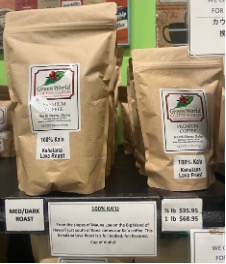
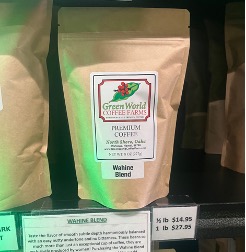
Green World Coffee Farm also makes a conscious effort to reduce waste. After harvesting, the coffee “cherry” is stripped away from the bean. Instead of discarding what would normally be considered waste, the farm works with a local tea maker who uses the cherries to infuse tea. In addition to coffee and tea, Green World offers a wide variety of products, ranging from chocolate-covered ginger to steak rubs, available through their website and retail shop.
Coffee is not native to Hawaii and had to be imported, as Coffea Arabica originated in Ethiopia. A Spanish seafarer named Don Francisco de Paula Marin landed on the Hawaiian Islands in the late eighteenth century. Marin was a skilled botanist who maintained connections with notable pirates of his time, allowing him to acquire seeds and plant cuttings of various crops. Coffee, pineapple, mango, cotton, and oranges are among the crops linked to Marin, and he is believed to have planted the first coffee seeds in Honolulu in 1817.
Chief Boki, the Royal Governor of Oahu and a member of the delegation that traveled to England, was first exposed to coffee and café culture in London. Recognizing its potential as a crop, Boki helped lay the groundwork for the introduction and later commercialization of coffee in Hawaii. The unique Hawaiian climate, with morning sunshine, afternoon rain, and mineral-rich volcanic soil, proved to be an ideal environment for coffee cultivation.
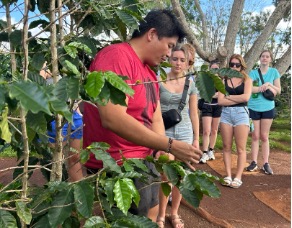
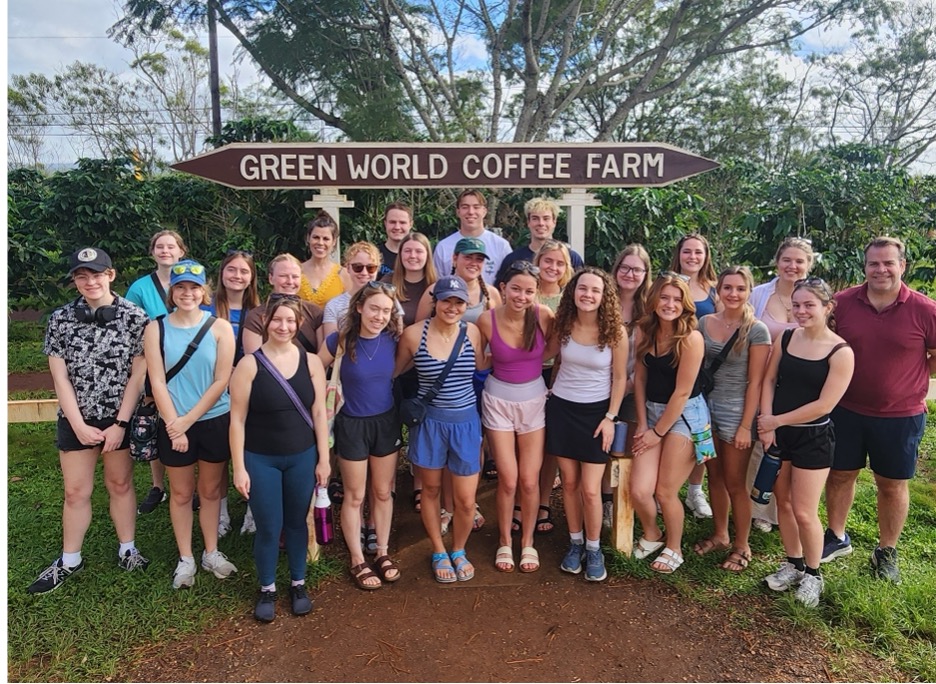
Our delegation of first year Honors students had a great time visiting Green World Coffee Farm and participating in the tour led by a wonderful and knowledgeable guide. Our guide explained to us how they do things and provided advice on what coffee we should buy if we weren’t sure. From walking through the coffee plants to ending at the coffee stand, we were able to try the coffees that were available for sale and see firsthand some of the process behind them.