Jon Meacham: The Pursuit of a More Perfect Union

Kaitlyn Hawker
Blog Editor-in-Chief
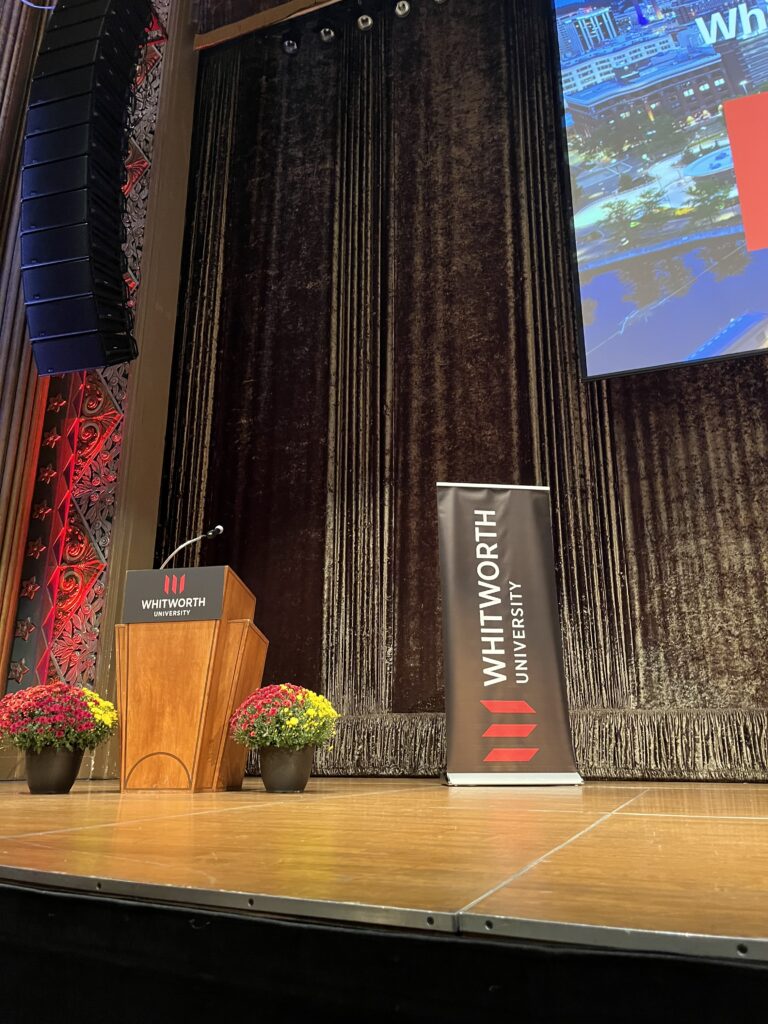
On October 14th, Jon Meacham visited Whitworth at President McQuilken’s 2026 Presidential Leadership Forum, this year hosted at the Fox Theatre.
Meacham is a presidential historian with many accolades such as a multiple New York Times Best Sellers and a Pulitzer for his book, American Lion: Andrew Jackson in the Whitehouse. He has written, co-authored, or edited biographies for Presidents Thomas Jefferson, George H. W. Bush, and Franklin Roosevelt. Though he also has an interest in the American Civil Rights Movement and key figures within it, such as John Lewis, the subject of his 2020 book, His Truth Is Marching On: John Lewis and the Power of Hope.
I attended his evening talk at the Fox called, “American Struggle: Democracy, Dissent, and the Pursuit of a More Perfect Union,” a nod to the title of his most recent book published earlier this year.
The foremost thing that struck me at the venue and especially as Meacham began talking, is that he had a very distinct audience—namely white people over 45—and though well-intentioned, he made a few off-color remarks and jokes that put me off but excited the rest of the crowd. His attitude towards women throughout the speech was lackluster to say the least.
The Body Politic and Medicine
He opened his topic with enlightening his audience to tight relationship between “the body politic” and bodily medicine. Corruption, Meacham claimed, comes directly from the vocabulary of medicine as an illness or disease that must be treated and remedied. A crisis, in ancient Greek, is the moment where a patient lives or dies. He highlighted this to illustrate the complex relationship between the physical health of an individual to the health of the ‘common life’ or the shared life of a community, state, or nation. A crisis in a nation spirals out into the physical body, a hearty populace supports and uplifts a sick common life.
This connection between the body politic and the physical body is the basis of his argument toward forming a more perfect union. But there must be some guiding principle or central throughline to align us on that goal. Meacham cited a sentence of the Declaration of Independence as the most influential sentence, rendered in English, in history, changing more lives around the world than any other.
“We hold these truths to be self-evident, that all men are created equal, that they are endowed by their Creator with certain unalienable Rights, that among these are Life, Liberty and the pursuit of Happiness.”
The Declaration of Independence
The American Gospel
Going so far as to call it the American Gospel, Meacham believes it is the ideas contained within those words that formed our nation and have contributed to every positive turn our nation has made in the last two hundred and fifty years. The United States is the first nation to tell everyone what we wanted to be at the birth of our independence. It is a contract the founders signed, and the American people have a responsibility to uphold every day. Meacham took the time to allow the Declaration is far more often adhered to after a breach of its principles, but to him that only strengthens his belief in the document.
He challenged the audience to find a time in American history when we did not follow the letter of the Declaration and forswear it, and to find a time when we did uphold our founding principles to glorify as a standard of American excellence.
“American democracy depends on our capacity to live up to the declaration. It also depends on our ability to win graciously and yes, to lose graciously. Without that we are a battlefield, not an arena.”
Jon Meacham
On battlefields, he posits, there are only enemies that must be destroyed. On the other hand, in an arena, we have rivals and opponents who can be defeated. American Democracy hangs over the ravine between defeating and destroying our opponents. It is crucial we land on the side of defeating rather than destroying.
Our Mission Statement
To put it in terms the audience might be more familiar with, Meacham related the Declaration as the ‘mission statement’ of the United States, and the Constitution as our ‘user’s guide.’
He also related the act of remembrance and memory to an active agency. When we remember things, we bring them back to life, piecing them together again, thinking about what made them whole in the first place. This idea can be applied to the Declaration too, anytime we read or hear about our ‘mission statement,’ we remember the principles contained within it and everything our nation has given to uphold them. We think about what drove people to die for the ideals of our nation.
No One is Coming to Save Us
Somewhat out of the blue, Meacham said, “Democracy can’t be outsourced. No one is coming to save us.” He followed it up with a joke about calling in a consultant to save the republic and having them send an invoice for their efforts. Yet, out of his entire speech, this is what stuck with me the most. We can’t hope someone will come in deus ex machina style and save us at the eleventh hour. While I’m sure he was referencing the United States as a nation, I took it to mean we can’t just hope our representatives will do what is best for us. It is our duty and responsibility, given to us by the Declaration and the Constitution to fight for a truly representative government that serves its people instead of its own ends.
Meacham concluded his speech with an anecdote about George H. W. Bush’s childhood, specifically how he helped pull one of his classmates out of barrel. When challenged dozens of years later why he did, he said he did it because he’d want someone to stop and help if he was stuck. Meacham believes the Declaration serves the same purpose. Thomas Jefferson wrote that critical sentence from ‘within the barrel’ in 1776 as an offering of help to anyone else who might find themselves stuck in a similar position.
We’ve taken up Jefferson on that offer in a dozen Amendments to the Constitution and in the hundreds of thousands of cases presented to the Supreme Court.
My Takeaways
While I enjoyed myself at the talk, I cannot agree with all his ideas. At its core, his thesis places an undue amount of weight and responsibility on the Declaration of Independence. It certainly is as influential as he claims, but I do not believe Jefferson intended it to be such. I can almost guarantee the Founding Fathers would be surprised and outraged at the state of the Constitution and our modern American government. And though Lincoln’s opinions on slavery changed enough to give the Emancipation Proclamation, I doubt he would understand all the social advances given to minorities in the last hundred and sixty years. None of these men understood the Declaration as we do now, and none of them intended for us to take it how we have.
Thankfully, we’ve nearly moved past the days when great swaths of our population were enslaved and denied a voice in government. We are getting closer and closer to true equality, which is helped along by those words Jefferson penned so long ago, but we cannot give him all the credit for our innovations.
Meacham takes away the agency of these great men by attributing their actions to the end goal of upholding the Declaration. There has not been a single day in our history where the words, “Liberty and Justice for all” or “all men are created equal” have rung true for every soul on our soil. The great men Meacham describes did what they could to guide the nation toward his vision of a better future… which is what every powerful man in history has done to mostly negative ends.
Lincoln, Jefferson, King, and others are certainly worthy of praise for their contributions to our democracy. However, just because the results of their actions aligned to benefit us now, does not mean they are wholly responsible for their impact. It is the people who took their words and spun them into fruit for our bodies and government. It is the fruit that continues to nourish the body politic today.